There’s a lot of paperwork comes into schools about well-being. The different techniques one can use to preserve one’s own physical and mental health. Sometimes, we get really nice posters to hang on the wall.
The thinking appears to be – ‘these teachers are stressed, let’s show them how to manage that stress well’.
For me, there’s a step missing in the logic. The syllogism is missing a step, the conclusion is therefore faulty. (I might have the terminology wrong here. After all, I last covered logic in 1989. Gulp)
Anyway. I agree with the first part of the sentiment. Teachers are stressed or unhappy with their career. This is to the extent that there are a number of teachers who either switch careers, or look to retire early as the personal cost is too great.
There are a number of factors in the profession that contribute to this stress:
- Changing Curriculum Requirements
- Outside influences on student work such as AI
- The points race
- The hated ‘Croke Park Hours’, that were brought in as part of Austerity and never rescinded
- Underfunding in schools
- The cost of training for new teachers
- Terrible contract conditions for newly qualified teachers
To suggest that all of these pressures are managed simply by providing staff with well-being is a nonsense. For two reasons.
Well-being is not a poster, it is a practise. To learn meditation, controlled breathing, or any number of techniques requires time and guidance. It requires a mentor who will guide one, in short, it requires investment. Not all can devote the time required to do this.
The second reason is more fundamental. Why should the onus be placed on the employee to manage stress when the sources of stress are external to the employee?
Many teachers feel that there is a disconnect between the Department of Education and the reality of how teachers work for their students. Any teacher I know has huge concerns about the new Junior Cycle and its methods of assessment.
There is a knock on effect in that students now enter senior cycle unprepared for the academic rigour required for those subjects which had been common level up to Junior Cycle.
This in turn leads teachers to question what will happen as the new Leaving Cert Curriculum is rolled out. One tag line does not inspire confidence “Preparing Students for the 21st Century”, when the first subjects will become active in 2025, a quarter of the way into the 21st Century.
Many, if not most, teachers see ‘Croke Park Hours’ as a punitive waste of time. These hours have destroyed much good-will due to the absolutist nature of how they are implemented: Must be on-site; must be accountable, etc. Must not be trusted.
Capitation for schools has not increased much in 18 years. In 2006 the standard capitation was €298 per pupil. (Source – Oireachtas). In 2024, the standard capitation is €345. (source: assets.gov) An increase of 16%. In that time the consumer price index shows inflation at 29.8%. Effectively, school capitation has been cut in those 18 years.
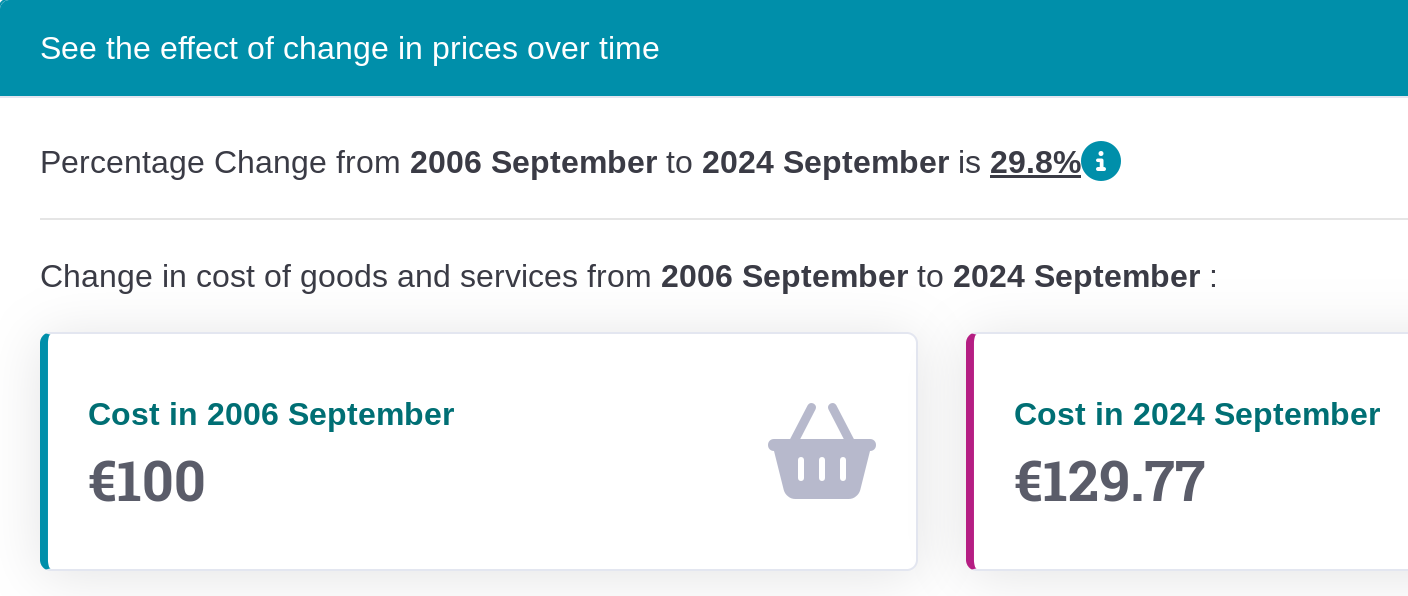
(source: https://visual.cso.ie/?body=entity/cpicalculator )
So. Next time somebody suggests I practise Well-Being. I will take the time to enlighten them as to how this covers up structural issues that need to be challenged.

 John Hurley