The Minister’s Real Speech

It’s A Tuesday in Easter…

Teachers, it’s a pleasure for me to have the chance to speak to & berate you today.

This is my fourth year addressing you, and I’m determined to make headlines today.  Enough of Man U holding the limelight today.

Now, where was I?  Oh yeah, the primary lot.

Yes.  We’re in a hole.  i’d like to blame the other lot, but I’ve used that line enough already. So let’s talk about how you lot are underqualified. First up, you only had to do three years in college to train as primary teachers, I’m changing that.  Plus, you lot aren’t good enough at maths.  Lets see, a starting point is that you’ll have to do honours maths for the leaving.  You see, girls are lazy.  You’re going to drop honours maths after the Junior Cert if we give you half a chance.  So, you have to keep it on.  So there.

Second.  I’m a bit upset.  All the women in here and I don’t even get a cup of tae?  What’s the point in having a feminised profession if you lot can’t even put on the kettle?

To address this, I’m changing the law.  We already have FEMPI, but I’m now changing the education act to get rid of teachers that are sub-standard.  And to keep an eye on these standards I’m the one who sets the standards.  There.  That should reassure ye.

Now, about this religious malarkey.  I got an idea yesterday.  How’s about we put the religion classes at the start of the day, or at the end?  I know, I know.  You then have students who have no room to go to.  Look, I know I’m taking as many teachers out of the system as possible, but can’t you just play musical chairs with them.  And yes, I do include all you lot who’d be in one-teacher-schools-if-I-get-my-way.

I’m not anti-religion. If it makes you feel any better, I’ll quote Hans Kung.  There, see?  But I will take the chance to boast that my first full day on the job was the day I started to look for ways to get the church out of as many schools as possible.

Remember I’m not anti-religion.  We must respect the rights of families who want their children to be given a religions education.  That’s in the constitution.  Unfortunately.

Later that day…

You lot are the secondary teachers, yeah?

First up.  Have you got around to telling me what you want yet?  Don’t bother with that resources rubbish.  I want to know what you want so that you will do what I want.

Here it is.  Let’s work to support inclusion and giving students a chance.  Let’s not let that bit about the guidance counsellers come between friends.  Come on.  You know that wasn’t a real job.  If the kids really cared then they’d find out what their subject choice and college options were.  I mean, that worked for me and my buddies in the bish.

Now.  the JCSA.  Let’s be clear.  We all agree that the current Junior Cert needs reform.  The best advice that I can get (while avoiding teachers) is that my pet-project is the way to go.  What we have isn’t working, and I’m the boss, so what I say goes.  Yes, I will pretend to keep listening to you lot, but consultation is not spelled n-e-g-o-t-i-a-t-i-o-n.

Now it seems to me that your unions don’t like what I have in mind.  So, I think that they aren’t doing their job.  They seem to think that you are not up to the task of working over 60 hours a week.  I say let’s prove them wrong.  I’ve already gotten away with taking about 20% of your pay, forcing you do do S&S and adding 33 hours of meetings.  Let’s face it, it’s not as if I trust you to work unless I get the principals to roll-call you after hours.

To re-enforce that point I’m changing the law and the Teaching Council will be allowed to continue the beatings until morale improves.

I look forward to seeing you all next year.  By then I hope that you’ll be too knackered to kick up a fuss.
The Aftermath of a Musical

In March our school held its musical, songs from Grease.  I wrote down some of my thoughts about it here.  Today, I’m in class and what’s next is a bit of a free for all with my TY class, where I’m asking for their memories of the show.  Just for the hell of it, I’m attaching their stage names to their answers!

What is your strongest memory of doing the musical?

‘Eugene’ getting to do my speech – loved doing it!

‘Sandy’ I loved working out Scene 5, and Scene 2.  They were good fun to do, some great songs.

‘Rizzo’ – my song.  Working together, having a laugh.  Roger’s ‘Mooning’ song with Jan.  My wig was very hot.  I was sweating under it.

One of the male cast ‘Sonny’ was shorter than the others, & was flung into the air a few times.

‘Frenchie’ – all the rehearsals. My wig made me  look like somthing out of ‘LazyTown’.

Building friendships with the directors. Jim & Co. from CADA

The Friday show was a surprise & one of the teachers had to fill in the role of ‘Frenchie’ at the last minute.

‘Kenickie’ – Jim (The Assistant Director)  was a top man.  Gave you confidence and got you into it.  He treated everyone nice.#

‘Doody’ –  The opening night stands out. We were all giddy backstage, but once the call came for 5 minutes we got all serious & everyone did their part.  I really remember the end of the show and we all started congratulating each other afterwards.

How much hard work went into it?

Everyone – lots & lots.

Learning the script was very hard.

Fast costume changes were difficult

You had to work during the mid-term break and over St. Patrick’s weekend.  How did you feel about that?

‘Rizzo’ didn’t like it, but it was worth it in the end.

‘Sandy’ it was grand. Just took it was worth it at the end.

Coming in during the breaks when your friends were off was hard.

What was the scariest part for you?

Doing the show in front of the school on the Friday.

The auditions were scary! (a lot of people said this)

‘Kenickie’ – my first time singing on stage was scary.

Tell me about the feeling of going on stage.

Nervous for some

‘Eugene’ says he wasn’t nervous!

‘Sandy’  I loved going on stage, nerve wrecking, but I loved it.

‘Doody’ – it was my first time on stage, nervous, afraid to mess up – and I never sang in front of people before.

It’s now nearly one month later.  What has the show meant for you?

We should have got a reward for all our hard work.

It built up my confidence in front of people.

We all get along better.  It has made us closer.

Surprised – I didn’t think I’d be able to get up on stage & speak.

The main director is scary!

I think there should be a musical every year.

‘Kenickie’ ‘Sandy’ & ‘Doody’ – it was the best thing in fourth year, made the year and it brought me much closer to a lot of the cast.  NO REGRETS

 Has it surprised you how much work has to go into gettting something on stage?

YES (from everyone).  The rehearsals went on for about 8 weeks. Especially in the little amout of time we had.  8 weeks really flew.

You managed to combine script, songs and dance in some scenes.

‘Rizzo’ I preferred doing the dancing & singing.  I didn’t really like the acting part.

‘Kenickie’ – it made the scenes, but it was much more difficult to do.  The acting was my favourite part.

‘Sandy’ I loved the singing and dancing.  Script was ok, but definitely preferred the singing and dancing.

And, from the backstage crew…

It was really, really dark!

Trying to move stuff backstage without making noise was difficult.

It was hard work.

Fin

And there you have it.  A little experiment during class with a group of tech-savvy fourth year students.  They loved doing the show, and I think really got the reward out of doing something so different to ‘normal’ class work.

And now, they can go home for 2 weeks of Easter Holidays.  Well done guys.

Education and Equality

We have an ideal that all students who enter our schools will be treated equally, that they will be treated fairly, and that they will be offered equal opportunities.

This is a myth.  Not true. Good PR.

You see, we live in an incredibly unequal society, and this inequality is reflected in our schools.  And this is a fact that our Minister for Education, Ruairi Quinn, seems to ignore.

So, just how does inequality show up in schools?

Well, all schools receive a running cost from the government depending on the number of students enrolled.  And yes, this does sound fair, but the costs of schools are such that the running costs will often exceed the money received from the government.  After all, taking the team to a match requires a bus, visiting the Young Scientist Exhibition or going on a field trip for geography requires money.  Some schools have more, some have less.  And this means the education experience of students can and will vary depending on the finance available.

You see, I don’t really believe the minister understands just what a disadvantage it can be to be from a disadvantaged area.  I mean how could he?  He hasn’t had to face a pay-cheque of less than €80,000 in years.  He went to a nice school (The Bish), and recently got to visit it with one of his advisers (coincidentally also a past pupil of the same school).

The thing is, if you attend a school where most of the parents have a decent wage, then the school looks for a top-up fee to support school activities.  These activities could include school tours, proper IT for classrooms (whether tablets, computers or whatever).

If your school is in a disadvantaged area, then things don’t look so good.   Being in a disadvantaged area you can expect to see higher rates of unemployment, lack of engagement with education, and social exclusion.  In short, schools could not in fairness ask for top up fees from these parents.  Any development is dependent on grants (which are getting scarcer).

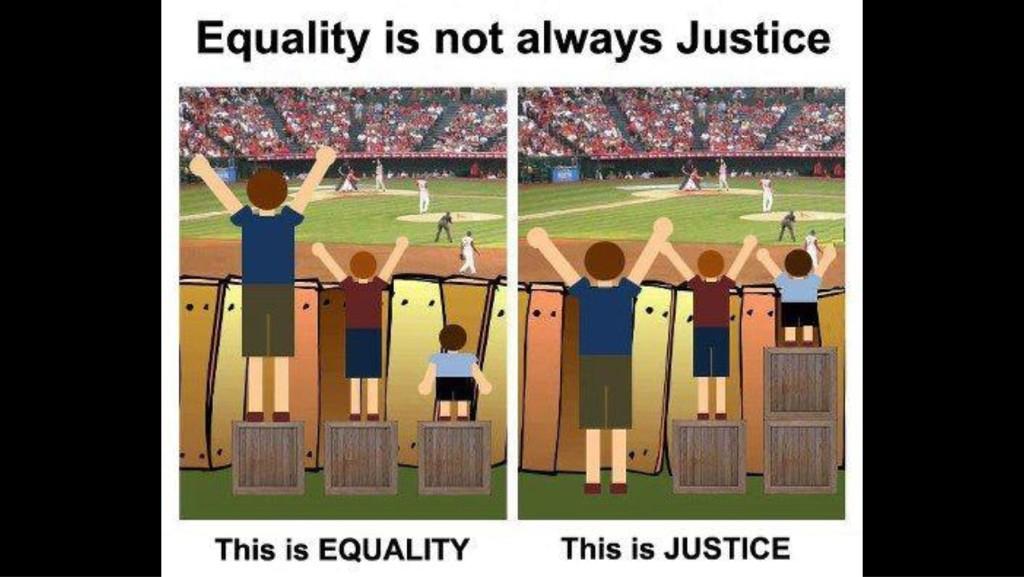
The picture looks a bit like this:


equality-justice

Just because schools receive a similar grant does not mean that the students will benefit from equal opportunities.  The playing field is not equal, a student who starts from a position of disadvantage will need extra help.

Our education system is in a lot of trouble at the moment.  Teachers are under pressure; we have a new Junior Cycle programme that is being rammed in despite the concern and opposition of thousands of teachers; school funding is being cut.

And yet, we claim we believe that education provides opportunities for students; that education is valuable; that education is more than just about measuring students. There’s a disconnect there and I hope that someday we get an education minister who actually believes in education and trusts teachers as professionals.

Our students deserve it.

The School Musical

Tonight, in Mayfield, our school musical will open, and there are a lot of nerves around the place.  Kind of the reaction that you would hope from the students.  But what a journey they have had to get this far.

I don’t know how many schools still do musicals as part of their Transition Year experience, but I hope that it’s a lot.  There is so much going on that it is something that, I believe, really adds to the whole TY experience, and benefits the students hugely.

Obviously, there is the sheer work of learning script and song.  There is the choreography, there’s the stage directions.  But unless you have been in one, it’s hard to comprehend just how much time is taken up with nitty-gritty details, and how much commitment is required from ALL of the cast and crew.

When the musical practices began, we had students who had never memorised a script, never sang in public, and never danced on stage.  And now they’re doing all three.  The students who were lucky enough to be picked for these roles have grown so, so much over the past few months that you cannot but be immensely proud of what they have achieved.  Add to that the effort put in by the back stage crew, those helping with costumes, props, and it really is an incredibly team effort.

The effort isn’t just confined to school time either.  We had students in each day of St. Patrick’s weekend.  And while they were in, they worked hard.  Ditto for the mid-term break.  They were all in, working their hearts out, and not complaining about it.

Anyway.  Sometimes it’s just good to remind ourselves about the good things that happen in our schools.  I’m looking forward to the show tonight, and again, just so proud of what the students have achieved.  Break a leg, guys.

The Start of a Campaign

On Tuesday 11th March teachers are being asked to spend their lunchtime at the gate of the school and protest against the introduction of the JCSA as it is presented.

In the immediate aftermath of the protest being announced there was a lot of differing commentary on some of the teachers’ Facebook Pages.  This division is reflected in some of the twitter feeds of the past week.  The initial reaction then is very mixed, and this can be very damaging to any campaign to oppose the JCSA. But such a campaign is necessary unless we are willing to accept a flawed programme.

So. What are the downsides of the protest?

  • Well, many people think that the teachers at the gate will be a laughing stock for their students
  • It is felt by many teachers that such a protest does not do anything to dissuade the minister, that the protest will lack any real punch
  • There is the real fear that if the protest is not well enough supported, then it may be seen by the minister as a lack of resolve by teachers

And what do we stand to gain?

  • People will see that teachers are willing to act in such a way that does not harm students’ educational attainment
  • A good turnout will send a clear signal to the minister that teachers are willing to stand their ground in order to oppose the current JCSA
  • This may in turn persuade the minister to engage properly with the unions and accept the criticisms and the concerns of professional teachers

First Steps

I’ve written before, listing concerns that teachers have about the JCSA, and I’ve also written how I see the current plan as the result of a solo run by the minister.  The TUI & ASTI have issued a joint document outlining the unions’ concerns.

Minister Quinn seems hell-bent on introducing the JCSA as it stands, and, so far, seems to be unwilling to listen to any concerns put forward by either the ASTI or the TUI.  I doubt that a 30 or 40 minute protest at school gates will do anything to change his attitude in this.

And that brings me neatly to the ballot which is being put to teachers shortly.  We will be asked to give the unions power to undertake industrial action and oppose the implementation of the JCSA.  We will be asked to approve a campaign of non-cooperation.

I will turn out on Tuesday to support the protest, but only because I see the protest as the first step in a broader campaign to raise awareness about teachers’ concerns.  In fact not just the concerns of teachers – parents of children who will be affected by these changes will have plenty to be worried about.

However, for any of this to work, both unions need to be able to send a clear message to the minister.  I believe he will ignore anything else.

I believe that we teachers need to stand together next Tuesday and raise public awareness about the new Junior Cert.  Beyond that we need to vote ‘Yes’ in the ballot for non-cooperation.  Most people recognise that the Junior Cert needs reform.  However, the JCSA is not what is needed.  There are too many concerns for it to go ahead as it is.  Lets work together to get our concerns addressed and give students a programme that will work and deliver for them.

By the way, the ASTI Nuacht outlining the protest and the ballot can be found here.

Consultations & Negotiations

You’d kinda have to have a bit of pity on our Education Minister, Ruairi Quinn.  He feels that the teachers of this  country don’t want to talk to him.  He thinks that we won’t actively engage with him.  He says he wants to talk with us.  He has further asked that teachers won’t go on a lunchtime protest in March as he doesn’t want to hurt students.  (That’s a bit rich coming from the man who took guidance counsellors out of schools)

The teachers aren’t willing to engage?

Hmmm.

I don’t think that I can quite agree with that point of view, Minister.  You see, you may have forgotten that we have a body in this country called the NCCA.  The National Council for Curriculum and Assessment oversees the development of curriculum from early childhood up to senior cycle.  Now.  Up until the minister did a solo run in October 2012 the NCCA had been working in conjunction with the unions and other stakeholders to revise the Junior Cert.

In November 2011 the proposals for a new Junior Cert were released.  The ASTI & the TUI released the news of the proposals, and were generally positive.  (In the ASTI pdf, look at p.16 & p.17)

So, for a while, all was rosy in the garden.  We had proposals for a new Junior Cert, agreed with the Unions, the NCCA and all under the stewardship of  our current minister.

And then, for some unknown reason, he changed his mind in 2012 and ditched the proposals.  He is according to the Irish Examiner,  unrepentant.  In fact, he looks down on teachers so much that he finds it necessary to spell out ‘negotiation’.  Basically, he doesn’t want to back down on a pet project and is upset by the fact that teachers don’t agree with a number of the tenets of his project.  He wants a consultation around implementation, not a negotiation about what’s appropriate.

The minister claims that he’s happy with “the professional advice” he has received.  From whom, may I ask?  Not the NCCA who were working with the unions.  Is he referring to his advisors? . And, if so, why should their advice rank higher than an organisation such as the NCCA which has been in existence for 30 years? Maybe it’s the fact that if he gets away with it, he can reduce the costs of the State Examinations Commission by removing them from any role of examining the JCSA.

I have serious questions about the professional advice that he took on in 2012, that is at odds with an agreed programme from 2011.  A good comparison between the two can be found here.  But a quick summary of teachers’ objections are: The new programme isn’t externally moderated, there is still a subject overload, who designs & accredits short courses?  Another issue is this; what’s to prevent a JCSA award from a posh Dublin school carrying more weight than a JCSA award from a school in a disadvantaged area?  The minister’s plan will re-enforce disadvantage in education.

And by the way, the advisors?   Well, go to The Journal.ie, for a full name list.

I’m mad as hell!

levdavidovic's avatarFintan O'Mahony

http://www.youtube.com/watch?v=wtfCRaNg5EU

20140213-165059.jpg

I’m frustrated. I’m frustrated and by the look of things I’m not alone. Educational change, needed, necessary, purposeful educational change in Ireland is being rolled out in an inadequate and disingenuous way.

At this stage I think we can all agree that the Junior Cert needs reform, no-one is proposing for a minute that the system we have now is ideal. Replacing it is a reasonable thing to do after 25 years, and you’d think after that length of time a well thought out and positive reform would be forthcoming but here we are six months before a new English is to be introduced and there’s no news on assessment, there’s one day of CPD in advance and the ‘toolkit’ for designing and producing the new content isn’t online.
I’m frustrated. Over the last few years I’ve attended ASTI meetings on Junior Cycle Reform, we even added an extra…

View original post 527 more words

New Junior Cert

(For anyone outside Ireland, a little information about what the Junior Cert is is at the bottom of the page.)

One of the important things to know about the Junior and Leaving cert is that the exams are totally impartial.  The papers are set and corrected by the State Examinations Commission.  I have corrected papers in the Junior cert (JC), and never had any indication about the the origin of the papers I corrected.  I never know the gender, background or address of any student.  I could not bring any prejudice or favouritism to the grades that I would award.  And that, I believe, is as it should be.

This brings us to the new Junior Cert.  Our minister for Education has decreed that the JC will pretty much end in 2016.  At that point the State Examinations Commission (SEC) will have no more role in correcting those papers.  The new programme is called the Junior Cycle Student Award.  It is based around 24 statements of learning.  The awards are granted by local schools, and the courses are assessed by the teachers within those schools.  This leads me to a few problems.

Impartiality

As I said earlier, one of the great advantages of the current JC is that the examiner never knows the student.  Whatever mark a student  receives is based purely on the students work and ability.

Under the new system teachers will be responsible for continual assessment, and grading their own students.  That’s it, the end of impartiality; welcome favouritism, or vendettas.

Or maybe what might happen is that I could design my own course, and give my students great marks, because I’m just that good.  Or what happens if my whole school tries this.  Suddenly, going by our results, it’s an absolutely outstanding school, ticking all the right boxes.  But what about the school just up the road?  Don’t they have the same success stories? What about the school that doesn’t worry about ticking the boxes, and instead focuses on student welfare, and achieving basic numeracy and literacy in an area of disadvantage?

It seems to me that by taking an impartial agency (the SEC) out of the process, the whole system becomes more open to abuse and manipulation.

Certification

A Junior Cert (or a Leaving Certificate) awarded to any student, anywhere in the state, carries the same level of validity.

The new Junior Cycle Student Award is fundamentally different.  Schools will follow a set of Core Subjects that are set nationally, but mix into this short courses and Priority Learning Units (PLUs).  (PLUs are designed to be used with students who may have learning difficulties)

Workload

At the moment teachers are busy people.  A teacher on full hours will teach 33 classes per week.  Under current agreements, the same teacher will be expected to supervise 45 minutes of break-time, and cover one class for other colleagues each week.

Lets look at those 33 classes.  In that the teacher will have a number of students who are preparing for state exams.  The teacher will be preparing for each class, and they will assign homework, class tests, and then correct all of the above.  The school day is busy enough to ensure all this won’t happen in a 9 to 4 day.  So, most teachers take work home with them.

Now.  What happens under the new regime?  Teachers will still have the existing workload but in addition will also have to administer continual assessment, and volumes of paperwork.  Because, to paraphrase, education must not only be done, it must be seen to be done.  Many teachers are worried about just how much extra workload will be loaded.


Casualisation of the Profession

Under our current system teachers are contracted yearly to teach a certain number of hours (not everyone has full teaching hours).  Under the new programme it is possible that teachers could be contracted for just the duration of a short course.

When this is tied to recent developments you get a clear picture that life is not very rosy for Newly Qualified Teachers.  Wages have been cut, and it is virtually impossible to get a full-time job.  (I have a number of friends who have been years teaching and are still not full-time)

The New programme may be the way to go, for example, students will undertake a maximum of 10 subjects, a cut from current practice.  However, I do think a lot of negotiation needs to happen in order for it to happen properly.


A little note on the Junior Cert & Leaving Cert

Secondary school students in Ireland face two state exams.  One at age 15, called the Junior cert, and one at about age 18, called the leaving cert.  These exams are huge markers for students.  The grades achieved in the Leaving Cert are a huge factor in access to further education for students.

The Junior Cert is a student’s first experience of state exams.  But it is more than just a marker.  Performance in the Junior cert can indicate to a student what level he/she should take on as they advance to senior school.

Rocks and Hard Places

So, here I am posting my ballot for the ASTI and our position on the Haddington Road Agreement (HRA).  This is not an easy decision to make.  We have all kinds of claims and counter-claims going on.

To set some context.  The Croke Park Agreement was due to last until 2014, and the government dumped it.  They signed an agreement, and when it didn’t suit, they binned it.  Naturally, this is a massive problem for anyone looking at the conditions of the HRA.  How long will it last, what of promises contained therein?  If the government can scrap one agreement unilaterally, what’s to stop them doing exactly the same again?  In short, I don’t trust the government to keep its word.

But, is the renegotiated HRA a good deal?  Obviously the full time members of the union think so, they wouldn’t have presented it to the Central Executive Committee (CEC) otherwise.  But that CEC have rejected it, and recommend that we, the members, vote no.

And what will happen if we vote no?

In a remarkable piece of scaremongering, the Department of Education and Skills released numbers outlining how many schools will close, and how much money teachers will stand to lose if they reject the HRA.  The Irish Times and other media have covered this.

  • An ASTI member who votes no will end up on about €660 per month less than a member of the TUI by 2020.
  • An ASTI member who joined after 2011 will have no access to the permanency panel
  • ASTI members in over-quota schools will be liable to compulsory redundancy
  • ASTI schools will have no posts of responsibility restored
  • No commitment to restore salary if the economy improves

And what if we vote ‘YES’?

  • Well, There’s a promise to reverse the cuts in 2017 and 2018
  • There’s a promise to review over-casualisation of the profession
  • There will be discussions on a fairer rostering system for Substitution & Supervision (S&S)
  • There will be discussions on how to make better use of the 33 out of school hours
  • There will be a new pay-scale for teachers who started after 2011
  • Pay increments will be awarded
  • We still get to do the extra out of school hours
  • All ASTI members will have to do S&S, but now members can opt out in return for a pay cut

None of the choices are good.  On one hand it looks like the government is trying to emasculate the unions, and even squeeze the ASTI out totally.  Also, a ‘YES’ vote brings many promises, and, based on what happened to the CPA, I don’t trust this government to keep its agreements.  By outlining the financial cost to members should they vote ‘NO’, the government has resorted to bully boy tactics.

On the other hand, the HRA goes some way towards restoring proper pay to new entrants. This was something which should have been fought earlier.  Think about it.  Just because someone became a teacher after 2011 they are entitled to a lower pay grade.

There is a huge divide among teachers on how to vote.  In her blog, Evelyn O’Connor is going for a ‘YES’ vote, and has been very eloquent in her reasoning for doing so.  Many teacher friends of mine are voting ‘NO’, and are equally eloquent in their reasoning for doing so.

Looking at what this government is capable of, I have no doubt that they will enforce the FEMPI legislation.  I believe that they will go for a full attack on teachers and are willing to close schools in order to enforce these cuts.

My instinct since the vote was announced has been to vote ‘NO’ but now that I’m at it, ‘YES’ seems to be the lesser of the two evils.  Neither vote is positive.  However, on the basis that parity of pay is closer for new entrants, and with the possibility that some elements can be examined I think that I don’t have the stomach for a fight.  I certainly don’t have the financial leeway to take the loss of pay that a strike would bring.

I’m angry, and I feel that the bullies are winning, I feel that in voting yes, I’m complicit in allowing the bullies to win.

There was a great line in Dr. Who’s “The Day of the Doctor”.

  • “We may fail, but at least we will have failed doing what we believe to be right, rather than succeed in doing what we know to be wrong”

I may not have that level of integrity.  However, I have at least made a decision and my vote will be counted.  I hope that there will be a high turnout by my ASTI colleagues, and whatever the vote, we will respect that decision, and stand together.

Art Therapy

Earlier this year at school we started discussing the idea of getting some support for our counselling service in school.  Just to recap – in our school we have two people who do counselling – a guidance counsellor and me as chaplain.

So, in our search for more resources we came across the MA in Art Therapy as offered by the CIT Crawford College of Art and Design. This MA programme takes mature students and works with their natural ability in art with their desire to help others,

Students of this programme must maintain their own art portfolio and each week spend time in studio. Along with this they learn about different aspects of psychology and how to integrate this knowledge with art in order to work with people who could do with therapy.

Two weeks ago I had the great chance to go to the teaching area for the course.  It was a great day, and I came away very optimistic about what this programme can offer our students.

From the start of the day, things looked good.  The other people present worked with various psychiatric services, addiction services, nursing services.  They all have trainees from the programme working with them, and had come along to tune themselves better into what can be expected, and how Art Therapy actually works.

For the first part of the day we learned about the structure of the course and what was expected of the students.

Next we went to a studio to experiment for ourselves.  We were given a task of producing something that expressed how we were.  To be honest we were supposed to produce something that expressed how we felt about different aspects of a student of the programme working with us.  And me being me, I forgot most of the instruction.  Anyway, we were given 20 minutes.

Anyway, I chose clay, and made this:

IMG_0664

Interestingly, I didn’t have a clue what I was going to do when I started.  I had vague ideas of doing  a head or something.  The point is, once you relax, it was possible to do things that you didn’t expect.

What’s this one about?  Moving from left to right, from tears (via a broken and repaired heart) to the rays of sunshine.  Many people who work to help others do so out of knowing what it’s like to be hurt themselves.

The last part of the day was the question and answer part.  This is where we got through the nitty gritty of how the placement system worked, and how we could adapt it to our own institution’s needs.

And so it begins.  In January we will have someone working in our school who is training on this programme.  I’m looking forward to it.  Some students may benefit very highly from something like this rather than just talking.  There is a lot of potential, and I reckon our students will stand to benefit from it.

Will there be more updates on this?  Nope.  State secrets at that point!

But, if you are interested in Art Therapy, here’s a link for you:  http://www.artincontext.eu/