Our Appalling Treatment of Ukrainian Refugees (IDPs)

Shortly after the invasion of Ukraine by Russia a flood of refugees (Internationally Displaced Persons) sought shelter across Europe.

At the time Ireland did all it could to help. Very quickly people were taken in at airports, PPS numbers were issued, and emergency accommodation was sorted. It was a moment of which I am proud.

Over the next few weeks and months we all realised that this war would take much longer than predicted, so our new Ukrainian neighbours began to integrate more into Irish society. They joined our schools, many started trying to learn the language, many more sought work and opened their own businesses locally.

In short, the Céad Mile Fáilte came into play.

As there is now a sense that the war is coming to an end, a number of Ukrainian families have made the decision to return home.

Some of those who have been lucky enough to find employment have found their own accommodation outside of the centres. A hugely positive move for those who could manage it. In the centres your space is not your own, and your privacy is limited. This option is not available to many due to the accommodation shortage across Ireland.

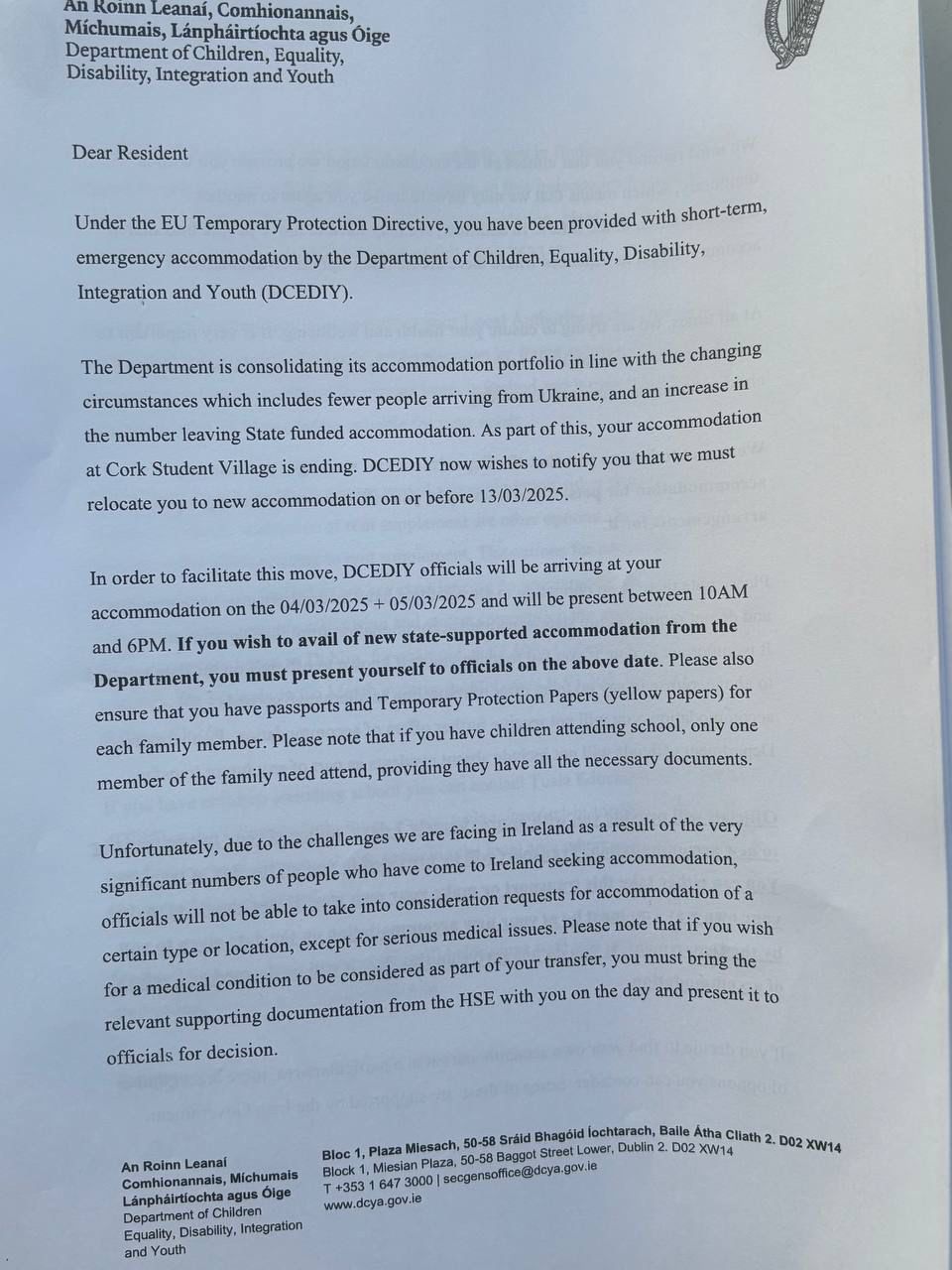
However the circumstances developed, the Department of Children, Equality, Disability, Integration and Youth has recently issued what are effectively hundreds of eviction letters to families and children across the country.

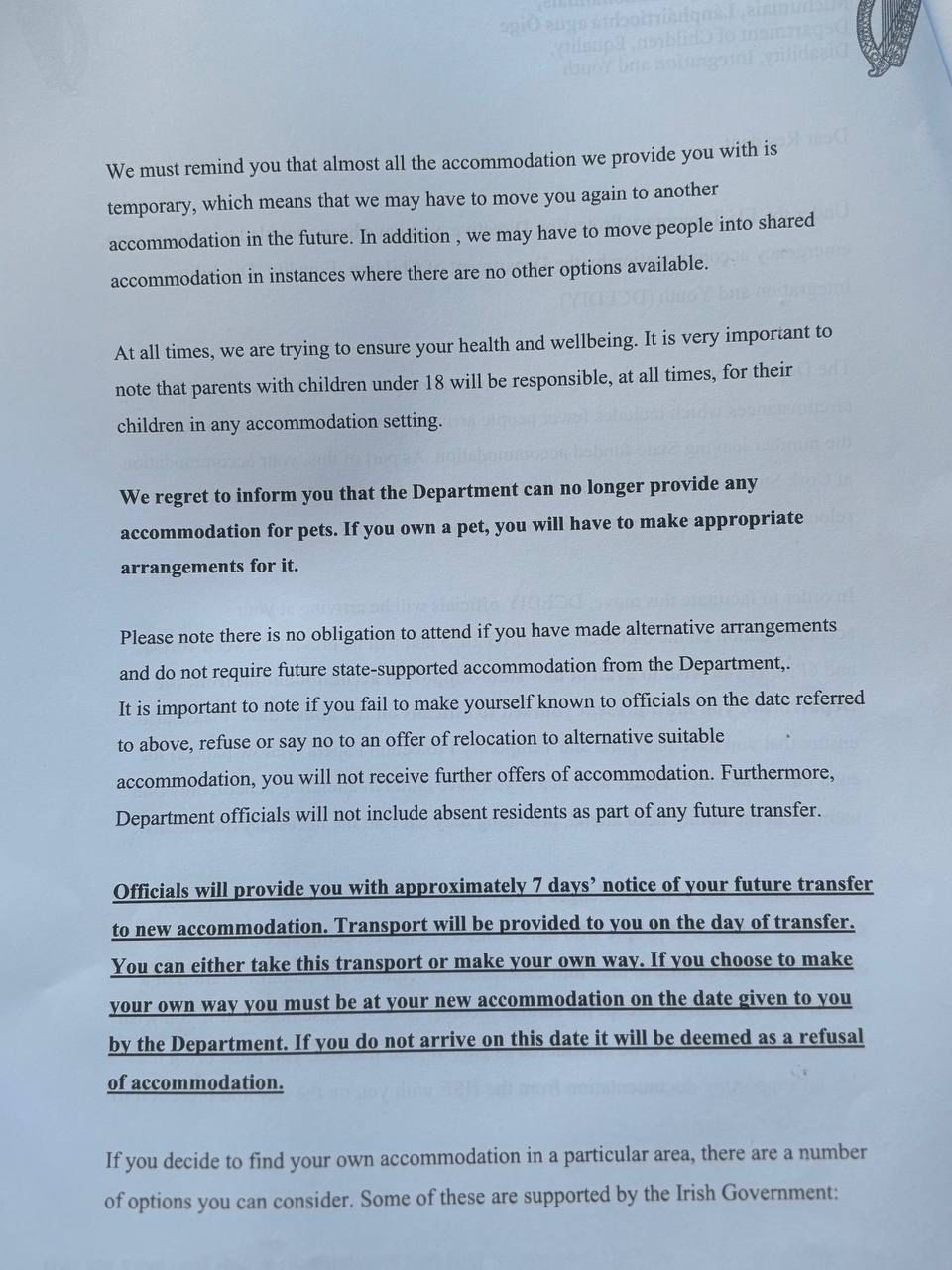
The letter is utterly devoid of compassion or humanity. The word ‘regret’ is used once, but only in relation to pets. The letter has caused an incredible amount of grief, stress and upset among those who have been unfortunate enough to receive it.

When the war began we took in traumatised people. We took in people who fled before the horrors of Bucha, we took in those who had lost their homes, we took in those who had lost family members.

We then talked about trauma informed practice, and, in schools at least, tried to keep this in mind when integrating our new students.

And now a department that is responsible for both children and integration is hurting children and undermining the integration that has been achieved. We are taking traumatised children, and retraumatising them

The letter provides the rationale that “the Department is consolidating its accommodation portfolio”. Two points here. The language in use is far beyond many of those who received the letter. Second, the department appears to be more concerned with a property portfolio than with the human beings under its supposed care.

The letter then gives a very tight timeline as to when these moves will happen.

In Youghal the residents at the Quality Hotel have been given about 2 or 3 weeks.

In Victoria Cross in Cork residents have been instructed to be available on 4th and 5th March between 10AM and 6PM with their documents. Failure to turn up will be seen as meaning that they are no longer interested in State Provided Accommodation.

Even better? They are then remined that they will be moved to temporary accommodation. In other words, don’t get too comfortable.

The damage this is doing to students is horrific. I know students who are preparing for State Exams and they don’t know where they will sit the exams. They do not even know if the town/city they are moved to will have a secondary school with the same option subjects. So they could end up not being able to complete their studies that they began 1.5 years ago for that option.

By moving students in the middle of the school year their studies are negatively affected. Even if they move quickly to a new school, the curriculum will have been covered in a different manner, different teachers have different styles, and the supports that a student benefited from are not immediately present.

The timing of this is very suspect. The Dail is currently not in session, so no TDs can make a minister answer questions in session. Was this deliberate, I wonder?

The letter appears to be unsigned – so who even is responsible for this decision?

The whole manner in which this has been done feels underhand. Again, the Department, in this action, is hurting children and undermining integration. All for the exercise of consolidating a portfolio.

There is now a series of articles being written, and more awareness about this issue. I really, really hope that something can be done to reverse this decision.

https://www.irishexaminer.com/news/munster/arid-41555347.html
Cork School Principal devestated
https://www.irishtimes.com/ireland/2025/01/14/were-very-afraid-ukrainian-refugees-in-limerick-given-48-hours-notice-of-being-moved/
https://www.rte.ie/news/regional/2025/0115/1491035-ukrainian-women-children-move-cork-hotel/

Why Well-being Gives Me Blood Pressure

There’s a lot of paperwork comes into schools about well-being. The different techniques one can use to preserve one’s own physical and mental health. Sometimes, we get really nice posters to hang on the wall.

The thinking appears to be – ‘these teachers are stressed, let’s show them how to manage that stress well’.

For me, there’s a step missing in the logic. The syllogism is missing a step, the conclusion is therefore faulty. (I might have the terminology wrong here. After all, I last covered logic in 1989. Gulp)

Anyway. I agree with the first part of the sentiment. Teachers are stressed or unhappy with their career. This is to the extent that there are a number of teachers who either switch careers, or look to retire early as the personal cost is too great.

There are a number of factors in the profession that contribute to this stress:

  • Changing Curriculum Requirements
  • Outside influences on student work such as AI
  • The points race
  • The hated ‘Croke Park Hours’, that were brought in as part of Austerity and never rescinded
  • Underfunding in schools
  • The cost of training for new teachers
  • Terrible contract conditions for newly qualified teachers

To suggest that all of these pressures are managed simply by providing staff with well-being is a nonsense. For two reasons.

Well-being is not a poster, it is a practise. To learn meditation, controlled breathing, or any number of techniques requires time and guidance. It requires a mentor who will guide one, in short, it requires investment. Not all can devote the time required to do this.

The second reason is more fundamental. Why should the onus be placed on the employee to manage stress when the sources of stress are external to the employee?

Many teachers feel that there is a disconnect between the Department of Education and the reality of how teachers work for their students. Any teacher I know has huge concerns about the new Junior Cycle and its methods of assessment.

There is a knock on effect in that students now enter senior cycle unprepared for the academic rigour required for those subjects which had been common level up to Junior Cycle.

This in turn leads teachers to question what will happen as the new Leaving Cert Curriculum is rolled out. One tag line does not inspire confidence “Preparing Students for the 21st Century”, when the first subjects will become active in 2025, a quarter of the way into the 21st Century.

Many, if not most, teachers see ‘Croke Park Hours’ as a punitive waste of time. These hours have destroyed much good-will due to the absolutist nature of how they are implemented: Must be on-site; must be accountable, etc. Must not be trusted.

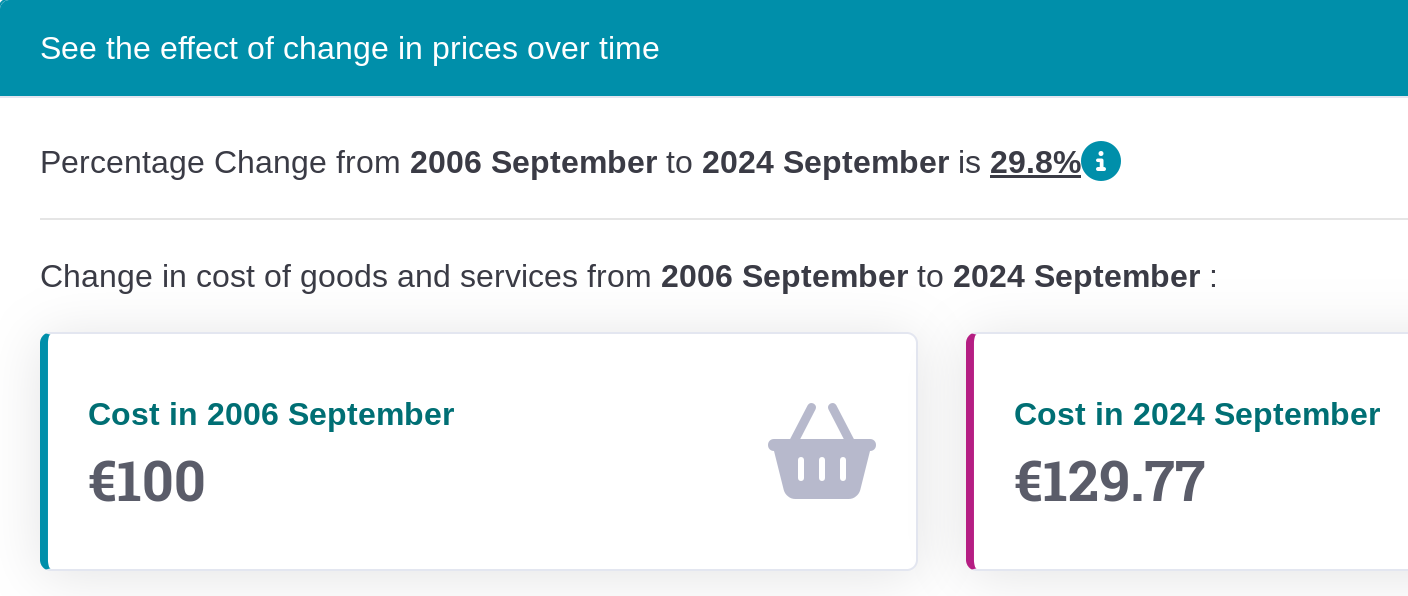
Capitation for schools has not increased much in 18 years. In 2006 the standard capitation was €298 per pupil. (Source – Oireachtas). In 2024, the standard capitation is €345. (source: assets.gov) An increase of 16%. In that time the consumer price index shows inflation at 29.8%. Effectively, school capitation has been cut in those 18 years.

(source: https://visual.cso.ie/?body=entity/cpicalculator )

So. Next time somebody suggests I practise Well-Being. I will take the time to enlighten them as to how this covers up structural issues that need to be challenged.

My problem with Junior Cycle Assessment

“You’re about to enter into the best in-service training you will ever get”

Those were the words spoken to a group of us in Athlone around June 2005 as we started our training to correct that year’s Junior Cert Religion papers.

That year I was involved in correcting Ordinary Level Religion. And what an experience it was. Just about every teacher will, at some stage, correct papers for the state exams.

The process is, frankly, impressive. Old as I am, this was in the paper days. Attend the marking conference, and then drive to the department to pick up your bundle of papers. The sheer volume of papers that you would receive was a bit of a shock to the system. No on-screen marking for us!

The following two years I corrected Higher Level Religion.

A few things struck me around the fairness of the system, and the opportunities offered to students of differing abilities:

  • There was a clear difference between Higher and Ordinary Level Papers
  • Questions were qualitatively different. At Ordinary Level more weighting was given to short answers so as to allow candidates an opportunity to do well
  • Higher Level tended towards more in-depth questioning
  • The language used in each paper had enough variation to suit the candidates taking that paper

The great thing about this system was that it allowed any student to do well and receive a grade that reflected their ability and effort.

An outstanding student could have a chance of achieving an ‘A’ (remember those?), while a student with challenges could have a decent chance to pass an ordinary level paper. There was plenty of graduation built into the system.

In 2012, 27,913 students took Higher Level Maths. Of these about 15% were awarded an A grade. (Source: https://www.thejournal.ie/junior-cert-results-591703-Sep2012/ )

In 2024, across 25 subjects the average number of students achieving a Distinction was 4%. (source: https://www.irishtimes.com/ireland/education/2024/10/09/junior-cycle-results-out-today-as-percentage-scoring-highest-mark-falls-in-most-subjects/ )

I have a few problems with the Junior Cycle. The biggest problem I have is with assessment. While we still have differentiated papers for English, Irish and Maths, we have common papers in other subjects.

If the Department is so convinced that common papers are the way to go, then why have differentiated papers for these three core subjects?

Next, if we could have had such a gap of ability and results in 2012, how is it possible to give a fair assessment to a range of students on a common paper.

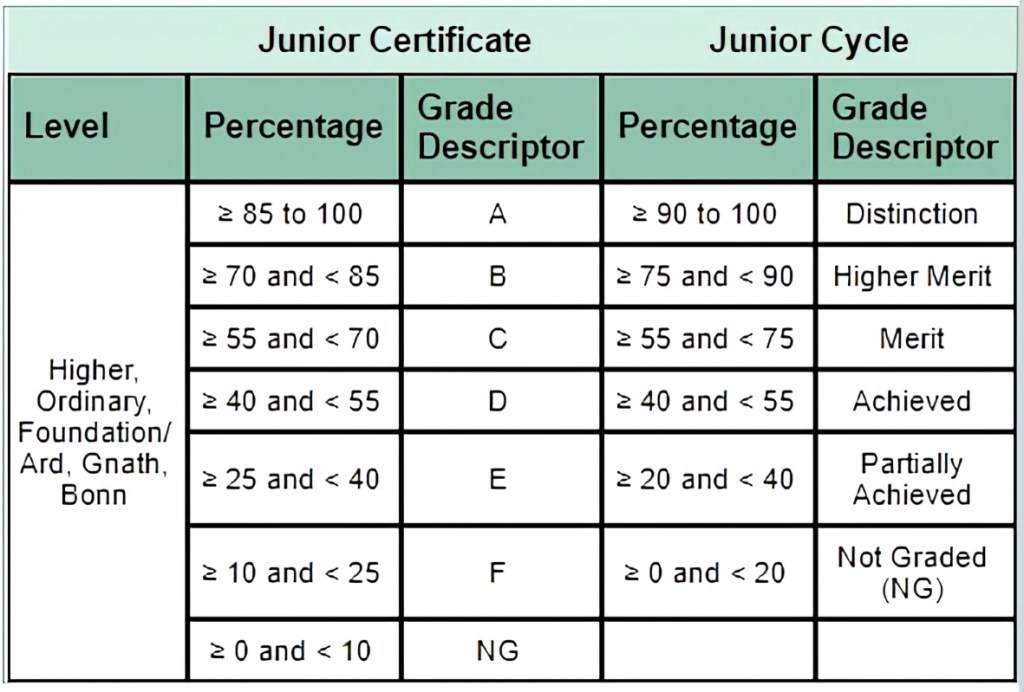
Finally, how is it possible that in 2012 15% of Higher Level students were able to get an A, but approximately 4% of students can now hope to achieve a distinction? This grade deflation is demoralising to those who have worked and who deserve to see their hard work rewarded.

I’m against the new Junior Cycle grading. I feel it’s fundamentally unfair to students (who don’t even like the nomenclature that goes with it). Unfortunately, as it is so new, I feel it will now be a very long time before any substantial change happens.

But before then, please have a look at the grading metrics, and allow those students who deserve a distinction, to receive that which they have worked for. 4% is not a fair breakdown in this case.

Our Own Worst Enemy

Education is a strange beast. It’s one of these public policy areas where everybody has an opinion – well, because everybody has some engagement with school.

Whether it’s our memories of primary, secondary, or (for some) college, we all have memories of our education that colour our perspective of what schools are, and hence, what schools can or should be.

For a number of years Irish governments have sought to provide a more empirical assessment of schools and Irish Education in general.

To this end we have the rankings from the OECD (The Organisation for Economic Co-Operation and Development), and its Programme for International Student Assessment (PISA)

Should a country fall back in its ranking, then there will be a huge fuss made. Programmes may be implemented, and blame may be spread.

As with many other countries, Ireland has high hopes for our Educational Attainment. This is measured in a number of ways: How many adults complete second level; what’s the combined score for reading, maths and sciences.

In 2018 PISA tested students in 79 countries. The average score for reading, maths and sciences was 488.

In Ireland the score was 505.

The PISA average for completing higher second level education is

Another key indicator for the OECD is ‘Educational Attainment’, by which they mean the percentage of adults from 18-64 who have completed higher second level education.

Ireland has an 85% rate for educational attainment, while Sweden’s rate is 83%. Close enough to identical. The OECD average is 79%, so both countries are ahead there.

Ireland’s PISA score was 505, compared to Sweden’s 503. The OECD average is 488, so both countries are well ahead.

(Source: OECD Better Life Index)

If we’re so close, why choose Sweden for comparison?

Well, the difference is in the spending. OECD has also tracked government spending in Education. As you’d expect, in Ireland we spend less than our international counterparts. (values are in US Dollar)

PrimarySecondaryTertiaryTotal
OECD Avg$10,658$11,942$18,105$40,705
Sweden$13,997$13,902$26,215$54,114
Ireland$9,589$11,379$17,400$38,368

(Source: Annual expenditure per student on educational institutions in OECD countries…in 2020, by country)

Ireland has long scrimped on spending in education. There was a brief moment of well-funded education in the early parts of this century, but the economic crash ended that. Ask any school leader and they will have stories of frustration and trying to scrimp and save in order to run their school.

So how is it that our education scores beat the OECD averages, even though we spend less on education than one of our closest matches?

Simple. As teachers we care deeply about our students, and will do anything within our power to achieve the best possible outcome for them. By refusing to let down our students, we have created an atmosphere where it is now expected that we continue to do so, despite continual underfunding. In this at least, we have become our own worst enemies.

When we are asked to compare Irish Education to Finland, then maybe we could take to heart this quote from the same OECD report:

“While teachers in Finland have always enjoyed respect in society, a combination of raising the bar for entry and granting teachers greater autonomy over their classrooms and working conditions than their peers enjoy elsewhere has helped to raise the status of the profession.”

So the next time anybody wants to talk about educational reform, here’s a radical idea.

How about funding Irish education properly?

Pesky Public Pensions

Those pesky public sector workers.  Them and their pensions are costing us money, and we need to sort it out.

Of course their unions are going to stand up for them, they are entitled to do so.

So runs the core of the argument by Paschal Donoghue, the minister for Public Expenditure.

It is now nearly nine years since the infamous bank guarantee, and we will be paying the cost of that mistake for years to come.  That mistake, on top of a property bubble and a global financial crisis created a financial crisis in Ireland that has cost us in an obvious business level, but also cost Ireland as a society: one just needs to look at the trolly crisis in hospitals, the cutting of resources in the Gardaí, in schools, in the broader public service.

It may have got old to say this by now, but the people being made to pay for the crisis were not the ones who created it.  The ongoing cost of the bank guarantee alone was something like €60 billion euro, with the interest costing approximately €1 billion every year. And yet, despite not being the ones to cause this crisis (it’s not over as we’re still paying the costs), members of the public service are still expected to suffer penalties.

For a while now the Fine Gael line has been that the public service bill is too high, and was part of the problem. And so, the public sector took some brutal pay cuts and changes to conditions in order to help the country as a whole deal with the mess that we, as a society, were in.

That cost has proven to be huge.

  • People have died while waiting on trollies in hospitals.
  • A&E units are swamped, leading to longer waiting times with greater stress on patients and medical staff
  • School resources cut and pupil/teacher ratios increased leading to poorer outcomes for many students
  • Longer working hours across the public service, less pay, and even less pay for those unfortunate enough to get their jobs after 2011
  • Wives and partners of those serving in the Army forced to protest because the pay is so poor

And yet, even with all this, the minister decides to push the idea that the public service costs too much and that he needs to cut where he can – with pensions the focus of today’s agenda.  Yes, we’ll finally reduce the pension levy, but must find a different way to get you to pay for the pensions.  So, um, get rid of the levy so long as we can keep the levy?

For me, there’s a premise behind all of this.  That the public service is a low-value cost, that should be cut where possible.  It’s a premise that I refuse to accept.

The public service is an integral part of Irish society, and is an excellent investment.

Just look at the work done by so many people across so many different parts of the public sector.  

  • Look at how hard our nurses and doctors work
  • Look at what teachers bring to and from their students
  • Look at the pride our navy has brought us from its mission in the Mediterranean

Fine Gael has managed to dominate the discussion of public sector pay by simplifying it to basic numbers.  An effective and healthy public service is more than a simplistic stating of the blunt cost.  The cost must be understood in context, and the value of what is achieved by the public service.  There is great value in the work being done, and it is Fine Gael that is devaluing it.

Fair and Equitable?

If one is to believe his appearances on news programmes recently, Our Dear Leader is a champion of all things ‘Fair and Equitable’.  In the government’s current spat with the ASTI Enda Kenny has resorted to a regular set of phrases designed to make the ASTI position appear to be, simply unfair (and possibly inequitable).

It really is a genius piece of spin.  Had we stayed within Lansdowne Road then younger members would benefit financially.  However, this is “contingent on the introduction of certain reform measures”  (have a look, paragraph 2 of the press release).  This all glosses over the simple fact that even with this increase, new teachers (within Lansdowne Road) are still paid a substandard starting salary in comparison to their pre-2011 counterparts.

The government is excellent at trumpeting good news in a manner to hide underlying facts.  The recent announcement regarding extra SNAs is really just a Cup and Ball Trick.

But I digress – Enda’s language got me thinking that if Fine Gael really is the arbiter of what’s fair and equitable in Education, then maybe FG policy is a shining example of how to treat the Education Sector with fairness.  So let’s have a quick recap of FG policies in relation to Education:

Repeated cuts in School Capitation

Capitation is the basis for a school budget.  Each school depends on capitation to pay the bills, hire the busses, get the books, repair the leaks, etc.  While all schools have had their capitation cut – this is inequitable.  Schools with a wealthier catchment area can rely on parents to subsidise some of the expenses.  Schools in a disadvantaged simply don’t have this option.

Increase the Pupil Teacher Ratio

In a larger classroom students don’t get the same level of attention.  It’s that simple.  Anyone who is claiming that a larger P/T ratio does not affect students is either untruthful or deluded.  Students benefit when their teacher can pay attention.

Get rid of Guidance Counsellors

It’s not easy to discern what you want to do with your life, and how to pick the best subjects and college courses for you.  That’s the job of guidance counsellors, and apparently one that the Government thinks we can do without.  Sure, they’ll argue that schools can now allocate resources as they see fit.  Really?  The choice is no guidance counsellor or yet larger class sizes.  Unless the school has the wealthier catchment area, in which case it may have the resources to fund a guidance counsellor.

Reduce supports for students with Special Education Needs

Fewer SNAs, fewer resource teachers. Think about this one – the group of students with the greatest challenges in school have had their supports cut.  How about that for fairness?

Strip resources for the National Educational Psychological Service (via the moratorium on employment)

NEPS provides huge support to schools.  One facet of this support is assessment – schools get access to a NEPS psychologist, and can provide some assessments during the year.  (Well, since the cuts, that now means ONE assessment for many schools).  Again, this is inequitable – some families can afford private assessments, some cannot.

Removal of middle management posts (Assistant Principal and Special Duties)

In any career people like to have the option of professional progression.  The removal of posts has removed that option for the vast majority of teachers.  Schools now depend on goodwill to get a number of jobs done – and this is putting more stress on principals and existing post holders.

Cut Teachers’ pay (in a number of ways – USC, Pension Related Deduction, Freeze increments)

Any teacher can look at his or her payslip and see all the extra deductions that are there.  The PRD grates as we have always paid into our pension, and have viewed a pension as ‘deferred pay’.  All workers suffer under the USC.  For a number of years we have had increments frozen.  The net affect of all of this is that teachers are still being paid less now than they were in 2007.

Cut Pay for the youngest teachers

I honestly don’t know exactly how this one happened.  Some say that the unions sold out the younger workers, and others say that this cut was done under FEMPI, beyond the control of the unions.  Maybe the unions were simply out-manoeuvred.  The simple fact is that our younger colleagues are on an inferior scale, and our government is unwilling to accept the principle that NQTs are entitled to equal pay for equal work.

Cut the rates and allowances for working for the State Examinations Commission

Just about every teacher has worked for a while correcting exams.  My first time doing it I was told I was about to undertake ‘the best inservice training ever’.  And it was.  The money was also pretty good.  However that has all been cut -and a number of experienced teachers have given up.  Come June and you will find the SEC posting ads for some positions that have not yet been filled.

Cut mileage and conference allocations

Attending conferences is good for professional development.  However, new rules mean that many of these conferences now take place on weekends, and any allowances for getting there are cut.  The fact that the conferences are still taking place is a testament to the professionalism of teachers who are giving up free time to improve their professional practice.

Change the sick pay entitlements

Nobody wants to get sick – but it is nice to know that if you get sick then there is a safety net to help. However the length of time this support is in place for has been cut.  Something that adds to the worry and stress of any teacher facing a serious illness.


Add to all of this we have a Taoiseach who has repeatedly been unwilling to give a straight answer to the question if he would be prepared to accept the principle of equal pay.

So, it’s a bit rich when Enda talks about his government working constantly for what’s ‘Fair and Equitable’.  His policies speak far louder than his words.  Fine Gael has overseen years of cuts in education and appears to have no intention to reverse these cuts.  Fairness and Equality have nothing to do with their policies.  The only thing that seems to matter is to balance a budget.

Stand Up

People who read this blog may know that I am no fan of Fine Gael.  Since their landslide victory in 2011 they have pursued an agenda that has led to terrible hardship amongst the poorer members of society.

Homelessness is on the rise, we still have direct provision, the health service is on its knees, we have multiple new taxes, and public servants (in the truest sense of that term) have had to make huge sacrifices For The Good Of The Country.  We were sold this sacrifice ‘For The Good Of All’, for the good of the country, and shur, dontcha know that it’s only temporary and we’ll get your pay back as soon as we can.

Well, weren’t we in for the surprise.

Across the public service workers were implicitly accused of being ‘unproductive’.  Apparently the cure for this was to cut staffing levels and ask everyone to work an extra 33 hours per year for free.  Please feel free to define ‘Productivity’ as it applies to doctors, nurses, gardai, or teachers.

Add to this the slashing of budgets, the degradation of working conditions, and a concerted media campaign have ensured a demoralised public service.  Let us not forget the fear factor.  FEMPI has been waved as a stick to go with the elusive carrot in negotiations.

Some of what has been done is reprehensible.  The different pay scales for new entrants is abhorrent.  It has also been used to drive a wedge into the unions.

You see, despite the claims that the unions have sold out their junior members, I think that its more simple and more depressing than that.  The government negotiators outmanoeuvred the unions.  I do believe the unions should have taken up the fight for young members a lot sooner.

However, as the saying goes, if the best time to plant a tree was 20 years ago, the second best time is now.

The unions are finally standing up for their younger members – and in some cases the fight is about restoring pay to pre-2008 levels.

And the government are going to fight this tooth and nail.  Just look at the use of FEMPI against ASTI members following the rejection of the latest agreement.

For whatever ideological reason, some branches of the media are backing up the government on this.  In the Independent today Eddie Molloy argued that giving into the unions would ‘hurt us all’. Of course he used far more emotive language.  Also today the editorial in the Indo refers to the GRA pay claims as ‘Brinkmanship‘, and that it ‘holds us all to ransom.

This stuff is hard to stomach.  Across the public service employees have faced sub-standard wages for the bones of a decade.  And yet now that we are told that the recession is over, now that we have been asked to ‘keep the recovery going’, now that the central bank can say that government finances are 1/2 billion ahead of target (again), now we are accused of being selfish.

Now is the time for the unions to stand together and fight for reversals of the cuts that have plagued the public service.  Of course there are differences of opinion within the unions.  We are democratic organisations and difference is healthy.  But enough is enough.  We need to fight the government and its anti-public service agenda.

And don’t buy the indo.

Edit:

I love this piece on Capuchin monkeys rejecting pay inequality:

Senior Cycle Debates

Today I was teaching Religion with a group of of Senior Cycle students, and we were looking at ‘The Search For Meaning & Values’.

I’d stumbled on the following interview with Kurt Cobain.  At one point he talks about his friendships with women, and how he felt that women were oppressed. (The clip is only 5 minutes long – and worth watching)

As a group we then started debating more about whether the group felt that women were actually oppressed in the modern world.

Unsurprisingly, the girls in the class all said ‘yes’ that women are oppressed.  Interestingly for me, they focused on the idea of women being expected to stay at home to cook and clean.  The guys felt that women were not oppressed.    And chaos ensued for the next few minutes!

The idea that women are not treated as equal was new (and news) for some of the lads gathered.  But, fair play to them, they were willing to listen and consider the implications.

I added the idea that oppression becomes apparent when women are excluded from top jobs in some companies.  But what really opened up the discussion was when we spoke about the Stanford Rape Case.  I brought up some sections of the victim’s letter (The full version is here), and it really brought up a good discussion among the students.  (Students?  They are young adults.  Some of the class are 18 years, and all have a maturity way beyond that which I possessed when I was their age).

What becomes tricky is how to handle such a debate when you have a group of young adults.  I have a particular set of values – and no guarantee that the students share them with me.  Of far more importance is the fact that students could be affected by what we were discussing.  When guiding such a debate you need to be familiar with your group.  The debate may not be appropriate or possible depending on who’s sitting in front of you.

I was so impressed by the quality of thought process of the students.  And of the basic goodness of many of them.  They dealt with many of the issues brought up by the letter in such a mature manner.

It’s a good start to the year with them, and I’m looking forward to many more debates.  Hopefully they will examine their own values in a conscious manner, and actively take part in developing their own sense of Meaning and Values.

A Lonely Road

So here we are at the start of a new year – still fighting the inequalities that were imposed on younger teachers in 2011/2012.

Currently, teachers are paid according to three different pay-scales.  Yup.  Just because any colleague of mine that had the misfortune to take up a contract a few years later than I did he/she would receive less pay for the same work.

Not only that, he/she will not receive any allowance for achieving excellence in their degree. (and let’s not forget that instead of a H.Dip.Ed, new teachers need a Professional Masters in Education – 2 years in college, and all the extra expense that second year adds up to)

You may remember that last Easter the issue of different pay scales was raised at the various conferences of the Teacher Unions.  The ASTI (of which I’m a member) gave a mandate that should the Government not address the issue of inequal pay by the end of August, then the union should take further action.

August is now behind us, and our newer colleagues still receive less pay for equal work.

The ASTI announced here that the union is to ballot members on taking strike action.

I’m proud that our union is taking this stand, and I will be more than happy to stand on the picket line to support my colleagues. (I know I’m assuming the result will be for a strike)

Yes, this will hit me in the pocket, but it is the right thing to do.  However much I have lost in pay (and I have lost a lot over the past 8 years), I am still better off than my colleagues.  This is beyond unfair – it is simply unjust, and must be fought.

Of course this won’t be easy.  At the moment only the ASTI is taking on this fight.  It’s going to be a lonely road.

And the government is ready to fight back.  Just look at the ferocity of the government’s reaction to the ASTI decision to not do any more Croke Park hours:

  • A threat not to pay increments in pay that are due
  • A threat to not pay for Supervision & Substitution (one of the cuts made early in the crisis)
  • A threat to deny new teachers a Contract of Indefinite Duration after 2 years of service.

Don’t think that the Government will accept the ASTI strike action and simply remove the 3 tier pay system.  They have the hated FEMPI, and they have shown they are willing to use it.  Expect them to retrench and hope to wear down the union.  Because if teachers get pay scales restored for new entrants then there are a lot of other members of the public service (who are also suffering) who will want to follow suit.

The INTO and TUI have their own battles trying to improve the lot of new entrants:

  • The INTO has given this update on their negotiations.  (in brief, the issue has not been resolved)
  • The TUI has given this update on their meetings with government negotiators.  (and they also have nothing resolved)

The other teaching unions may at some point decide that protracted negotiations are not getting new teachers any closer to an equal and just payscale, but in the meantime ASTI members may feel very alone on the picket line.

Stand Up


Richard Bruton and his Cup and Ball Trick

A few days ago our new Minister for Education and Skills, Richard Bruton announced an increase in the number of Special Needs Assistants (SNAs) in the Irish School System.  Not just one or two, but 860 new SNAs.

This sounds brilliant, and a lot of it is good news.  But I have a fear that there is a lot of plastering over the cracks going on.  Why?  Well there are three main areas that are glossed over in the reports:


Population increase.

Ireland’s Population is on the increase.  The 2008 population of Ireland was 4.46 million, and the 2015 population was 4.63 million according to this site. That’s an increase of 170,000 people.

The CSO estimated that the primary school population would go from 502,300 to 556,500 in the period from 2011 to 2016.  In the same period the secondary school population was to grow from 342,400 to 368,600.  That’s a total increase of 80,400.  I think it’s fair to assume a number of those students will need the help of an SNA, don’t you?


Shifting Goalposts

In this Irish Examiner article I found the most misleading statement from the Minister to be that every child who needs an SNA will have one.  However, the Department of Education has shifted the goalposts regarding what constitutes “need”.  This article from RTE mentions students who need help with toilet or mobility issues.  The entitlement is restricted to those students with physical needs.

Really?

Yes, students who have physical needs require and deserve support, but what about the student with ADHD, the student who is diagnosed with Autistic Spectrum Disorder?  What about students with a range of conditions that prevent them from functioning to their best ability in a mainstream classroom?

Students who would have qualified for an SNA ten years ago are denied access to an SNA under the new regime.  This fact is being buried under an announcement that highlights a necessary increase, but does not address the very many students who have no support.  And this can only hurt their educational achievement.


It’s all about the Money, Money, Money

Minister Bruton has said that the money for the extra SNAs will come from his existing budget.  That really doesn’t bode well.  The Education budget has seen some brutal cuts over the past eight years.  I doubt very much that it will be possible to strip assets from one area without causing significant damage.

As it stands the Irish Government seems to be pursuing a policy of Education by budget rather than by aspiration.

And as for Minister Bruton?  He has, rather cleverly, diverted our attention to a good news story so as to distract us to the ongoing affect of continued Austerity in Education.

cup-and-ball-trick