I don’t want to go on strike. I need to go on strike.

Some of our students are very clued in.  On Friday one of my leaving certs approached me with his phone and gave me the news of the upcoming strike.  Good for him.  He’s interested in what’s going on in the world.

And yet he represents one of the many students who I will walk out on, come December 2nd.  He’s a great guy, his classmates are great, and I’m sure this is replicated across the country, and yet here we are.  We, the members of the two secondary school unions have voted for strike.  Here’s the joint statement from the unions.

So.  Why are we going on strike?

There is one core issue.  Assessment.

You see, up until now the Junior Cert has been assessed externally.  This is important because it means that little Johnny from Mayfield is on the same playing field as Alistair from D4.  It’s an incredible logistic feat, but when a student sits a state exam, their paper goes to a different part of the country, and the examiner knows nothing – nothing about that student.  This is a vital part of the integrity of the system.

In his time as Minister for Education, Ruairi Quinn wanted to do away with this and replace the Junior Cert with the JCSA and have it assessed in-house.  This was a sea change and, if accepted, open to abuse.  A JCSA certificate from my community school would not carry the same prestige as one from an up-market fee-paying school.

Our new Minister, Jan O’Sullivan has tried to reach a compromise in this.  She has offered 40% internal assessment, with an oversight element.  This is still not good enough.  For a number of reasons:

  1. We have still broken from the principle of external assessment for the exams.  This would still mean teachers marking their own students work.  Who is to say that this isn’t open to abuse or manipulation?  What pressures will be brought to bear on some teachers to bring up the marks of their students?
  2. The syllabus is due to change.  And where are the resources to implement a new syllabus?  Syllabus change and development is necessary.  I think that all teachers accept that we need a revision of the Junior Cert.  In fact, we had agreed to this in 2011, and had a plan in place.  But any change of this magnitude needs proper resources.  Teachers need training, updating in their skills.
  3. Building a project for assessment.  Have you ever tried to get 25 students to complete a project?  It can be… interesting.  There is a balance to be struck between driving the students and spoon-feeding them all the answers.
  4. Time.  When is the marking of this 40% due to happen?  A teacher with 33 class periods in a week is already struggling with time pressures.   If that teacher has students sitting the state exam, then he/she ends up having to correct the work for the state in an unpaid manner.
  5. Where is the educational merit of the decision?  Why does the minister not want to move on the 40% number?  Money.  The less work that is corrected by the State Examinations Commission (SEC), the better.  It saves money.  In it’s original form, the JCSA appeared to be a precursor to phasing out the SEC.

Look at some of what’s been done (in the name of educational reform)

  1. Remove Guidance Counsellors from secondary schools
  2. Increase the pupil/teacher ratio
  3. Cut capitation grants to schools
  4. Again, cut capitation grants to schools (and again for next year)
  5. Reduce supports for students with Special Educational Needs

I’m being a bit long-winded, so back the core issue.  Why are we going on strike?  Because teachers should not assess their own students for a state exam.  Add to that, (speaking for myself) I don’t trust the motivations behind these measures.

So. It’s time to act.  It’s time to let the Minister and her government know that enough is enough.  Education has been attacked long enough.  I don’t want to go on strike, but I need to.

Just what are schools for?

It’s the kind of question that can get you thinking.

Depending on who’s standing on a soapbox, you could be led to think that schools are responsible for any number of different, and possibly contradictory, functions.

  • Schools should prepare students for science
  • Schools should prepare students for business
  • Schools should prepare students for the world of work
  • Schools should prepare students for the arts

and so on.

In the midst of all of this there is the juggernaut of assessment.  The cycle of PISA brings panic and hysteria to departments and newsrooms as whole countries try to reassess how they are doing in competition with their neighbours.

I have previously stated my reservations around the Narrow Focus on Assessment, but for a better reply to PISA than I could ever write, have a look at this piece written in the Guardian.

But schools are, I  believe, more than just about turning out utilitarian units destined to be productive members of the business community or of industry.

I think that the piece of Irish Legislation dealing with the running of schools (The Education Act, 1998) actually gives a good idea of what schools can be.  In Section 9, (d) the Act states that schools shall “promote the moral, spiritual, social and personal development of students, and provide health education for them

That really opens it up.

The children we take into schools will one day leave as adults ready to take their place in the world.

Yes, some will go on to be business leaders, and yes, some will go on to be innovators, entrepreneurs, productive employees.

But not all of them.

There will also students who will not find a job, there will be the students who may be too ill, or have too great a disability to work.

The students who leave our schools will go on to become parents, friends and neighbours.  They will be members of communities and clubs, they will be a part of society.  And how do our schools serve them?

Schools are not something that are separate, where students are trained.  Schools are a part of society.  They are places that children grow and develop.  They are messy complicated places full of little (and large) dramas.  Schools have got ranges of students of differing abilities, and differing personalities.  Schools are full of students fighting their own battles and still trying to do their best.

We already know this.  But in the face of the constant pressure of assessment, we sometimes forget it.

There is a great line in Terry Pratchett’s ‘Small Gods’.  In a scene where a library is burning, some characters argue over which books to save.  As one fights for scrolls on maths and engineering, another fights for literature and philosophy “these teach us how to be human!” he cries.

I like that.

Schools are places full of humanity, and places where we learn to be human.

Maybe, ultimately, this is what schools are for.  Places where we learn to become human.

Getting Started in Google Drive

I’ve written already about my school getting started with Google Apps for Education.

For a next step, I was thinking of what are basic skills that students need if they’re to make use of what’s on offer.  So I put this together to give students (and staff?) an idea of how to get started.  Is there anything I’m missing in this step?

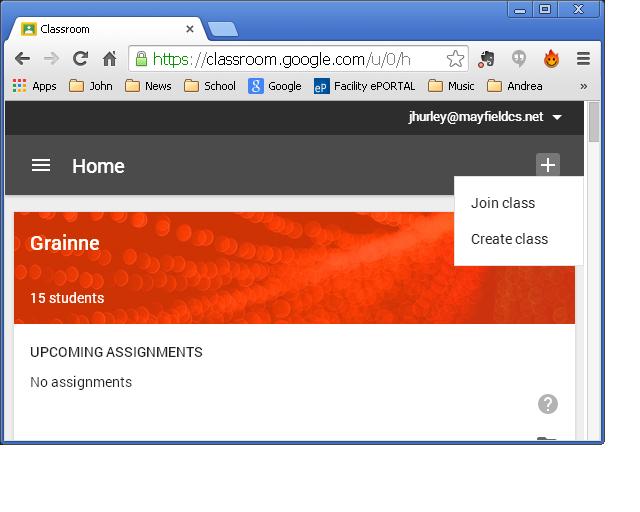
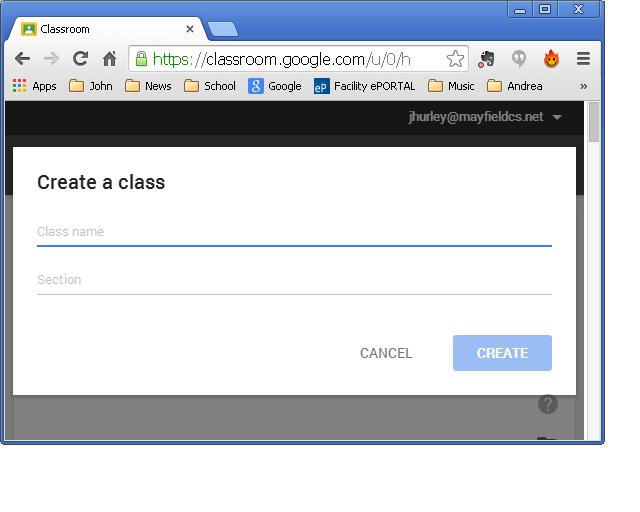
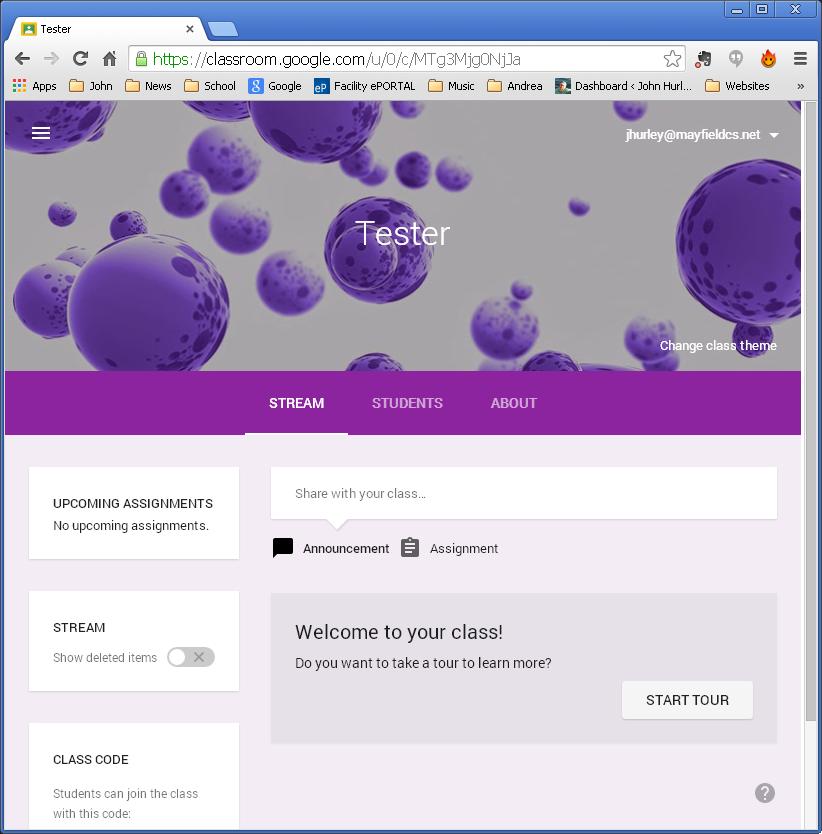
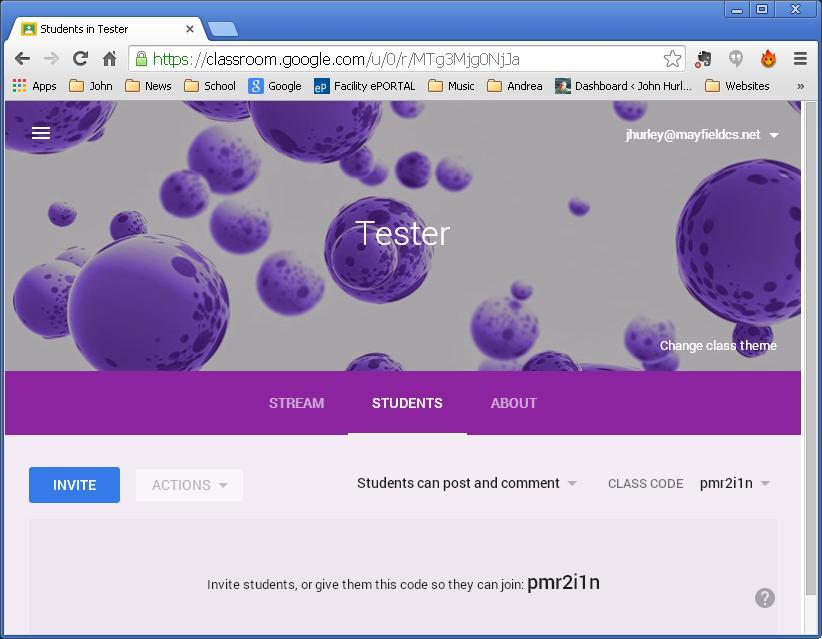
When you sign into your Google Account you will see at the top right hand side of the screen the apps menu.  Click on the icon that looks like a grid.

apps toolbar


You will then see this drop down menu:

apps toolbar 2

Click on the Drive icon.  If you are using Chrome then Drive will open in a new tab.  Not sure about other browsers.

Once Drive is open, it’s time to learn how to create a document.

menu

At the right hand side of the screen, you will see the shiny red ‘New’ button.  Click on this.

menu 2

Once you get the drop-down menu, click on the option ‘Google Docs’

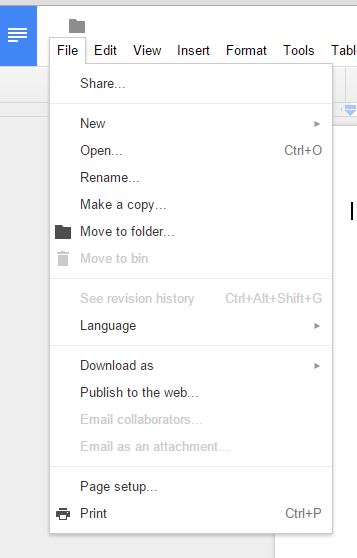
Again, if you’re using Chrome, a new tab will open.  This is your new document.  At the right hand side of the screen, click on ‘File’ and rename the document.

rename file


This will give you a small window where you can give the document a new name:

rename file 2

Once you have renamed the document, learn how to put in text, and format your work.

sample document


To create a table, simply point your mouse to the ‘Table’ heading in the toolbar and use the drop down options:

make a table

As with most computing skills, the only real way to learn this stuff is to try it out.  You can see the table I chose is 6 columns across by 4 rows down.  Simple to add!

Go on.  Give it a try.


Lets discuss the Teaching Council

I’m conflicted.

The Teaching Council is the body that is charged with overseeing the profession of teaching in Ireland.  So, you would imagine that I would be all in favour of this.  After all, I’m a School Chaplain.  I spend my working days in schools and I witness the professionalism of my colleagues on a daily basis.  I see their hard work, dedication, inspiration.  I should be glad of anything that promotes that professionalism and recognises the hard work of so many teachers.

The Teaching Council is tasked with protecting the integrity of teaching.  It regulates “the teaching profession and promotes professional standards in teaching”.  Why then are so many of us angry with it?

My first taste of disillusionment with the Teaching Council came a few years ago, when the attacks on education (AKA the austerity budgets) were slashing resources and pay across the sector.  Many teachers wrote to the council asking them to speak up on their behalf.  In response we got the response that the council was all for protecting standards, yes.  But had no role in budget discussions.  I never kept a copy of the letter, but I’d love to be able to show it to you.

As the past few years have advanced, the Teaching Council has flexed its muscles more and more.

First, teachers who didn’t pay the €65 per annum registration would not be paid by the Department of Education & Skills.  This became an open threat with this press release stating that over 1,000 teachers could lose their pay.

Then we hear that the council has the power to investigate teachers.  Have our registration fees added up to become a war chest?  On what basis would teachers be investigated?

Most recently, the idea was proposed that teachers would have to engage in CPD in order to maintain their registration.  Admittedly CPD is very, very important.  But when technology changes so fast, and there are so many different ways in which to learn, who decides what is valid CPD, and who certifies it?  My interaction on Monday evenings #edchatie over on the tweet machine is something that is incredibly valuable.  I have learnt a lot by looking at what so, so many other teachers do.

My fears are not new, and they are not unique to me.  Have  a look here and here to see others’ concerns regarding the Teaching Council.

One problem is that many teachers have no faith in the Teaching Council, or see it as irrelevant.  If you do a twitter search for #teaching council you get one screen of results.  One screen for a body that has been in existence since March 2006.

So what is to be done?

  1. Be more flexible in recognising qualifications.  Engineers are good, very good, at maths.  People who qualified as teachers in other countries are teachers.  Don’t make it impossible for them to register here.
  2. Look at the registration fee.  Currently the Teaching Council is running a surplus of millions of Euro.  Use it or don’t charge it.
  3. Provide more courses that people want to engage in (or need to engage in, or would benefit from engaging in)
  4. Talk to the DES about getting course days and subject association days covered for substitution.
  5. Trust teachers.  Allow teachers to work together to create their own CPD.  Online interactions are very fruitful, but difficult to quantify for certification purposes.
  6. Do more to engage with teachers and see what we want for the development of our profession. There is little engagement at the moment.
Embed from Getty Images

Through The Cracks

There has been a lot of talk in the media over the past few days about the crisis in the health system in Ireland.  Things are pretty grim.

According to the Irish Examiner, waiting lists have soared 968%.  In other words, if you are on a waiting list, you wait almost 10 times as long now to be seen.

And this is scary.  But it is not the full picture.

As a culture we are still hesitant to discuss mental health. As a result, we don’t get the full picture of the difficulties faced by so many people in crisis.

According to Aware, up to 10% of young people suffer from depression at any one time (my emphasis)

According to this document from the CSO, in 2005/2006 there were 335,134 students in second level education (see p.115)

If we put these numbers together, you have approximately 35,000 second level students suffering from depression at any given time.  I find this a very upsetting statistic.  Not just for the fact of the depression that the students are battling, but for the fact that we have so few resources to help the students in need.

Schools themselves have limited resources.  In an incredibly callous display of disregard for students, our former minister, Rurai Quinn removed guidance counsellors from schools.  (It remains to be seen whether our new minister, Jan O’Sullivan will reverse this decision)

I don’t want to give the impression that schools should be the place to fix these issues.  A school’s function is to educate students.  Schools are not places to treat issues around mental health, just as schools are not places to treat broken bones or other physical ailments.  Schools can run programmes to promote mental health, but if you’re sick – then you need a doctor.

However, just as schools can provide support for students with broken bones and other physical ailments, they are also places that can provide support for those in pain.

Or at least they could if they had the resources in place.  With all the staff cutbacks (especially that to guidance counsellors) schools are hard pressed to do all that is expected of them.

No.

More is needed in supporting our teenagers in trouble.

We do have some excellent groups in Ireland, for example:

  • Aware is working to help those suffering from depression.
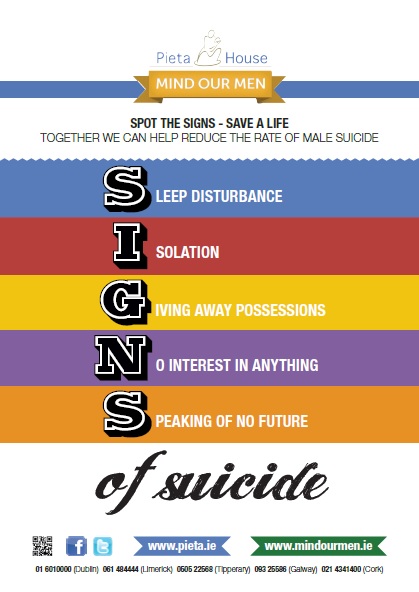
  • Pieta House works to help those who are suffering from suicidal thoughts or deliberate self harm
  • Console helps those suffering, either because they are thinking of suicide, or because someone close to them has died by suicide.

But our health system is not able to cope.  We don’t have enough psychiatric beds to help those in serious pain.  Our social workers are understaffed and overworked.  Counselling via the health service has a huge waiting list.

In short, our mental health services are not serving our teenagers effectively.

It’s not just the teenagers who are left fall through the cracks.

In this article the Irish Times highlights that 554 people in Ireland died from suicide in 2011.  We all know families who have been devastated by the loss of someone they love.

As a society we need to do a lot more to look out for those around us.  We need to do a lot more to look out for those who fall through the cracks.

SIGNSnobleeds

Formerly Honourable

Sometimes you just have to wonder what people are thinking when they talk about teenagers and what they get up to in schools.

In this article in the Avondhu newspaper in Fermoy from August 28th, it seems that a formor local councilor thinks that some arson attacks in the area will be solved once students get back to school.

“Maybe it’s because the schools are on holidays” he says.  Really, Cllr O’Donovan?  Just what does he think happens within the four walls of a school?  What does he actually think of young people?

Does he perhaps worry that teachers and other staff need stab-vests in school?  Is he hoping that we will install metal detectors and security guards?  Maybe the poor man has been watching too much dodgy telly.

It’s also possible that he hasn’t seen the inside of a school in a very long time and just doesn’t know what a challenging, interesting and rewarding place a school is.

No two days are the same, no two class groups are the same.  And just as the philosophers debated if the same river passes under a bridge, the group you meet today could generate a totally different dynamic tomorrow.

Schools are great places to be.  The chance to see students learn, develop, mature and go on to college or other walks of life is hugely satisfying.  And this all happens in the 21st century, not in some kind of Dickensian workhouse.

So whatever our formerly honourable councillor  was thinking, he was being thoroughly unfair to students and schools.

Utterances like this make me think it’s just as well that some of the councils were abolished this year.

Dear Joan, or Alex

On July 4th the Labour Party will begin counting votes on who will get to be the new leader of the party. This will hopefully be a fairly straightforward and quick poll, and we will know who will lead the party from its worst electoral defeat.

Add to the new leadership in Labour is the likelihood that there will be a cabinet reshuffle during the Summer.  This, I once hoped would be a cause for joy, but I’m beginning to get a bit cynical now.

You see, Joan (or Alex), people who had previously believed that Labour would stand up for them are sadly disillusioned.  Cutbacks and austerity in health, education and social welfare are being touted as achievements.  Surely they are the exact opposite?  Labour ministers have led the charge to cut back in their own departments in the name of keeping the Troika happy, in the cause of shoring up the gambling debts of Ireland’s elite from the Tiger Era.  Is not keeping rich investors happy the very antithesis of what Labour stood for?

And here’s the thing.  The Troika recently called for the government to keep on track with a further 2 Billion Euro in cutbacks this year.  They announced this in the middle of your leadership campaign.  This, to me, is a clear signal as to who really calls the shots.

To take a note from Minister Quinn’s playbook, it seems that the Troika think Labour’s job is to consult on the cutbacks, not to negotiate them.  So I wonder how much will actually change.

From a teacher’s point of view, I used to hope that a cabinet re-shuffle would rid education of Ruairi Quinn, and that we would have a minister who would listen to teachers, rather than his own fabled advisers. I hoped that we could get a minister who would listen to concerns around Special Needs Provision, around concerns with the JCSA, around concerns with Pupil Teacher ratios; around management of schools, around the proper resourcing of education.  Now I doubt that much would actually change.  Yes, we may get a minster who talks a better talk, but I’m beginning to think that nothing will actually change.

You see, Joan, or Alex.  I think you have forgotten the marginalised in this country.  I think that you have forgotten about just how much hardship has been endured by normal people.

I really hope that I’m wrong.  I really hope that you heard the very clear message given by the Irish Electorate in May.  I really hope that you will finally realise that Austerity has run its course.  Ireland should not be just about balancing the books.  Ireland should also be about the quality of life of all its citizens.  More so for the most vulnerable among us.

Or, to quote Gandhi: “A nation’s greatness is measured by how it treats its weakest members.”

In very many cases recently Joan or Alex, we have failed this test of greatness.  What are you going to do about it?


First Communion & Our Primary Schools

Let me tell you a story, it’s a sad story, so please don’t laugh…

There was this little school where all the children got on well. All the boys & girls were well prepped and worked towards getting ready for their First Holy Communion.

The day arrived and the class assembled in church, going over their moves when the teacher noticed that little Mary was missing.  Mary never missed a day so the teacher got worried and she phoned Mary’s family.

“No problem,” they said “we got held up at the hairdressers so we’re going to skip the church and go straight to the hotel”.

I believe that First Communion in this country has gone in the wrong direction.   I first heard the above as an urban legend, but it has an air of possibility about it.  And that, for me, is sad.  First Communions and Confirmations are happening all over the country at the moment, and the commentary isn’t far behind.  Last year I remember Matt Cooper interviewing the owner of a Limo business who put in a policy that he wouldn’t accept First Communion bookings.  Why was the policy even needed in the first place?

A little context, First Communion is what is termed a ‘Sacrament of initiation’.  There are three of them: Baptism, confirmation, and Eucharist (Communion).  The idea is that a child on having taken part in all three sacraments will be a full member of the Catholic Church.  Very early in the Church’s history the three were separated out.

Funnily enough, in the modern world, they are not always separated.  A convert to Catholicism will receive all three in one go (in a rite called RCIA), and in the Orthodox church, all three also happen in one go.

Due to the Church having such an integral role historically in our primary schools we have a situation where the school is the place where children learn about, and are prepared for, the sacraments of Communion and Confirmation.  The sacraments have become rites of passage where the emphasis has moved towards the finery and the money spent rather than on the sacrament itself.

I’m against this.  Yes, make a big deal out of a sacrament if you want, but since when should 8 year old girls be worried about a dress costing €200 or more?  Since when should they have fake tan?  Since when is the contest in school later about how much money in gifts they got?

I think that I may agree with Ruairi Quinn on something.  <did I just say that?>

Like him, I think that it would be a good idea to take some of the preparation for communion out of the school.  Instruction in Religion could still happen in school, but move the responsibility for the sacramental preparation to the parish.

This has started in some places.  In my own parish children and their families attend a series of masses in preparation for their own Communion.  A group of parents meet on a regular basis to plan and prepare.  The links in the community are strengthened and those who choose to be part of the Church deepen their understanding.

Make communion something that a family, that a child has to opt into in their own time and you will very quickly find out the ones who actually want to be involved for what it is – part of the journey in the Christian Faith.

Things can’t change fast enough for me.  One of my daughters will receive her First Communion next year, and I would far prefer her to wear a pretty dress and not worry about the hype than be dressed in a miniature wedding dress and comparing hair-dos.

Lets put away the farce of Fake Tans and the Limos.  Let First Communion be for those who want to take part. Do away with the crap that has built up around it.


Emer O’Kelly Rebuttal

The following was written by Mairéad De Búrca in reply to Emer O’Kelly’s article in the Irish Independent. 

I’d like to thank Mairéad for giving me permission to publish her letter here.

John.


I am pleased that the Sindo published my response to Emer O’ Kelly’s unwarranted attack on teachers. However, my letter was edited to remove many criticisms of EOK’s article. I will copy the published letter and then my original letter to show you what I mean. To get the full picture, you should read her article first http://www.independent.ie/opinion/analysis/ruairi-quinn-should-teach-these-wolves-a-lesson-30221231.html

My letter is a point by point rebuttal of her piece.

Published Letter –

MINISTER HAS DONE NOTHING BUT CUT

Madam – Well done to Emer O’Kelly and the Sunday Independent for once again writing hateful bile about teachers. (Sunday Independent, April 27, 2014).

Teachers most certainly do not earn €60k on average per year. The ministers she praises earn multiples of a teacher’s salary and get tax-free expenses and perks. Why not attack them? Teachers pay into their pensions every week for 40 years. Teachers do not have jobs for life. Teachers can be, and are, dismissed. Thousands of teachers have no jobs at all.

The minister is destroying our education system. Teachers try to point this out when they can. Teachers have a duty to point this out. Journalists have this duty too. Minister Quinn is about as far away from being a socialist or a trade unionist as Emer O’Kelly is. He attended private schools. He sent his children to private schools.

He most certainly is not the best Minister for Education, since anybody! He has actually done nothing during his tenure except cut, cut, cut, speak to the media, cut, cut, cut, spin, spin, spin. He is arguably the worst Minister for Education I have ever encountered. He has failed utterly in his oft-stated intention to wrest the control of education away from religious denominations. It is disconcerting that Ms O’Kelly views this complete failure of his as a success.

This minister has not only failed the education system, he has failed Ireland’s children. Of course teachers must call him on that, especially if journalists like Emer O’Kelly fail to do so. I stopped buying the Sindo years ago due to the astounding amount of teacher-bashing in it.

Dr Mairead De Burca,

The full text of my Letter:

Madam,

Well done to Emer O’ Kelly and the Sindo for keeping up your long tradition of poor journalism. Emer, you get 10/10 for writing hateful bile about teachers once again. 10/10 also for not bothering with actual facts. 0/10 however, for accuracy, objectivity, research and journalism, so that’s a FAIL, Emer. Here is a critique of your latest “work”, point by point:

1. Teachers most certainly do not earn 60K on average per year. The Ministers you praise in your article, however, earn multiples of a teacher’s salary and get un-vouched, tax free expenses and perks also. Why don’t you attack them?

2. Teachers pay into their pensions every week for forty years. Ruairi does not. What do you say to him?

3. Teachers do not have jobs for life. Teachers can and are dismissed. Thousands of teachers have no jobs at all.

4. On what basis do you describe the ASTI as the “cream level” of teachers?

5. The Minister in charge of Education is destroying our education system. Teachers try to point this out when they can. Teachers have a duty to point this out. Journalists have this duty too.

6. Minister Quinn is about as far away from being a socialist or a trade unionist as you are, Emer. He attended private schools. He sent his children to private schools. He earns an enormous salary. People call him a champagne socialist. I call him a capitalist.

7. Dignity and grace are not words I would use about Minister Quinn. He spins statistics without grace or dignity to make himself look good. He cuts educational supports to our children without grace or dignity.

8. He most certainly is not the best Minister for Education, since anybody! He has actually done nothing during his tenure except cut, cut, cut, speak to the media, cut, cut, cut, spin, spin, spin….. He is arguably the worst Minister for Education I have ever encountered.

9. I have never heard Minister Quinn tell the truth, as you claim. He spins statistics and reads speeches prepared for him by his many, very well-paid advisors.

10. It is the Minister who continuously self-congratulates himself. He thinks he’s doing a great job, and tells teachers this all the time.

11. He veers between saying our teachers are the best in the world to saying they are not. Make your mind up, Minister.

12. He has failed utterly in his oft-stated intention to wrest the control of education away from Religious denominations. It is disconcerting that you view this complete failure of his as a success, Emer.

13. This Minister has not only failed the education system, he has failed Ireland’s children. Of course teachers must call him on that, especially if journalists like you fail to do so, Emer.

14. As regards the Honours Maths and anti-women gaffs which this man “mis-spoke” in front of INTO members… Emer, please stop trying to defend the indefensible. He, himself, knows he made a mistake saying what he said. The whole country knows it, except you.

15. Andrew Phelan of ASTI has explained his actions very thoroughly on his FB page. Why didn’t you read what he had to say while you researched your own piece, Emer? O that’s right, sorry, I forgot that you don’t “do” research.

16. The new Junior Cycle is under-funded, under-resourced and unplanned. You think that’s good, do you, Emer? Teachers do not. Parents do not.

17. Teachers are the greatest advocates for children and young adults in this country, Emer. You are not. Minister Quinn is not. You could use your position as a journalist to help teachers to advocate for children, Emer.

18. You advise Minister Quinn to emulate Minister Shatter? Really? Do you really believe that anyone should emulate Minister Shatter given the scandals in his Department?

Emer, the least you could do would be to check out a few facts, do a bit of work, before you sit down to your keyboard. I stopped buying the Sindo years ago due to the astounding amount of teacher-bashing in it.

If we have learned anything last week, and again today in the Sindo, it is that some newspapers attract entirely the wrong kind of people into “journalism”.

Yours Etc…

Dr. Mairéad De Búrca.
The Minister’s Real Speech

It’s A Tuesday in Easter…

Teachers, it’s a pleasure for me to have the chance to speak to & berate you today.

This is my fourth year addressing you, and I’m determined to make headlines today.  Enough of Man U holding the limelight today.

Now, where was I?  Oh yeah, the primary lot.

Yes.  We’re in a hole.  i’d like to blame the other lot, but I’ve used that line enough already. So let’s talk about how you lot are underqualified. First up, you only had to do three years in college to train as primary teachers, I’m changing that.  Plus, you lot aren’t good enough at maths.  Lets see, a starting point is that you’ll have to do honours maths for the leaving.  You see, girls are lazy.  You’re going to drop honours maths after the Junior Cert if we give you half a chance.  So, you have to keep it on.  So there.

Second.  I’m a bit upset.  All the women in here and I don’t even get a cup of tae?  What’s the point in having a feminised profession if you lot can’t even put on the kettle?

To address this, I’m changing the law.  We already have FEMPI, but I’m now changing the education act to get rid of teachers that are sub-standard.  And to keep an eye on these standards I’m the one who sets the standards.  There.  That should reassure ye.

Now, about this religious malarkey.  I got an idea yesterday.  How’s about we put the religion classes at the start of the day, or at the end?  I know, I know.  You then have students who have no room to go to.  Look, I know I’m taking as many teachers out of the system as possible, but can’t you just play musical chairs with them.  And yes, I do include all you lot who’d be in one-teacher-schools-if-I-get-my-way.

I’m not anti-religion. If it makes you feel any better, I’ll quote Hans Kung.  There, see?  But I will take the chance to boast that my first full day on the job was the day I started to look for ways to get the church out of as many schools as possible.

Remember I’m not anti-religion.  We must respect the rights of families who want their children to be given a religions education.  That’s in the constitution.  Unfortunately.

Later that day…

You lot are the secondary teachers, yeah?

First up.  Have you got around to telling me what you want yet?  Don’t bother with that resources rubbish.  I want to know what you want so that you will do what I want.

Here it is.  Let’s work to support inclusion and giving students a chance.  Let’s not let that bit about the guidance counsellers come between friends.  Come on.  You know that wasn’t a real job.  If the kids really cared then they’d find out what their subject choice and college options were.  I mean, that worked for me and my buddies in the bish.

Now.  the JCSA.  Let’s be clear.  We all agree that the current Junior Cert needs reform.  The best advice that I can get (while avoiding teachers) is that my pet-project is the way to go.  What we have isn’t working, and I’m the boss, so what I say goes.  Yes, I will pretend to keep listening to you lot, but consultation is not spelled n-e-g-o-t-i-a-t-i-o-n.

Now it seems to me that your unions don’t like what I have in mind.  So, I think that they aren’t doing their job.  They seem to think that you are not up to the task of working over 60 hours a week.  I say let’s prove them wrong.  I’ve already gotten away with taking about 20% of your pay, forcing you do do S&S and adding 33 hours of meetings.  Let’s face it, it’s not as if I trust you to work unless I get the principals to roll-call you after hours.

To re-enforce that point I’m changing the law and the Teaching Council will be allowed to continue the beatings until morale improves.

I look forward to seeing you all next year.  By then I hope that you’ll be too knackered to kick up a fuss.