Education and Equality

We have an ideal that all students who enter our schools will be treated equally, that they will be treated fairly, and that they will be offered equal opportunities.

This is a myth.  Not true. Good PR.

You see, we live in an incredibly unequal society, and this inequality is reflected in our schools.  And this is a fact that our Minister for Education, Ruairi Quinn, seems to ignore.

So, just how does inequality show up in schools?

Well, all schools receive a running cost from the government depending on the number of students enrolled.  And yes, this does sound fair, but the costs of schools are such that the running costs will often exceed the money received from the government.  After all, taking the team to a match requires a bus, visiting the Young Scientist Exhibition or going on a field trip for geography requires money.  Some schools have more, some have less.  And this means the education experience of students can and will vary depending on the finance available.

You see, I don’t really believe the minister understands just what a disadvantage it can be to be from a disadvantaged area.  I mean how could he?  He hasn’t had to face a pay-cheque of less than €80,000 in years.  He went to a nice school (The Bish), and recently got to visit it with one of his advisers (coincidentally also a past pupil of the same school).

The thing is, if you attend a school where most of the parents have a decent wage, then the school looks for a top-up fee to support school activities.  These activities could include school tours, proper IT for classrooms (whether tablets, computers or whatever).

If your school is in a disadvantaged area, then things don’t look so good.   Being in a disadvantaged area you can expect to see higher rates of unemployment, lack of engagement with education, and social exclusion.  In short, schools could not in fairness ask for top up fees from these parents.  Any development is dependent on grants (which are getting scarcer).

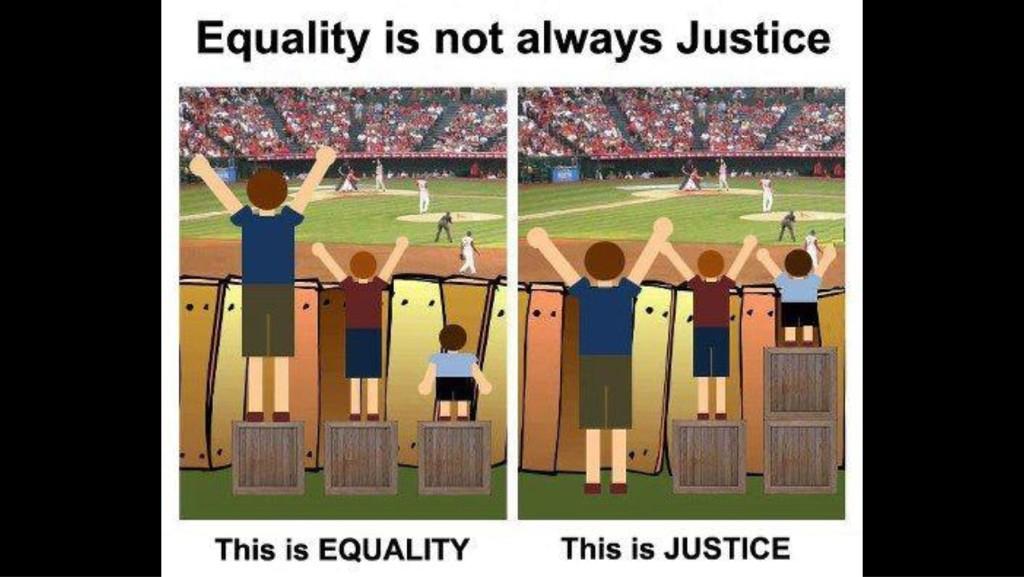
The picture looks a bit like this:


equality-justice

Just because schools receive a similar grant does not mean that the students will benefit from equal opportunities.  The playing field is not equal, a student who starts from a position of disadvantage will need extra help.

Our education system is in a lot of trouble at the moment.  Teachers are under pressure; we have a new Junior Cycle programme that is being rammed in despite the concern and opposition of thousands of teachers; school funding is being cut.

And yet, we claim we believe that education provides opportunities for students; that education is valuable; that education is more than just about measuring students. There’s a disconnect there and I hope that someday we get an education minister who actually believes in education and trusts teachers as professionals.

Our students deserve it.

Consultations & Negotiations

You’d kinda have to have a bit of pity on our Education Minister, Ruairi Quinn.  He feels that the teachers of this  country don’t want to talk to him.  He thinks that we won’t actively engage with him.  He says he wants to talk with us.  He has further asked that teachers won’t go on a lunchtime protest in March as he doesn’t want to hurt students.  (That’s a bit rich coming from the man who took guidance counsellors out of schools)

The teachers aren’t willing to engage?

Hmmm.

I don’t think that I can quite agree with that point of view, Minister.  You see, you may have forgotten that we have a body in this country called the NCCA.  The National Council for Curriculum and Assessment oversees the development of curriculum from early childhood up to senior cycle.  Now.  Up until the minister did a solo run in October 2012 the NCCA had been working in conjunction with the unions and other stakeholders to revise the Junior Cert.

In November 2011 the proposals for a new Junior Cert were released.  The ASTI & the TUI released the news of the proposals, and were generally positive.  (In the ASTI pdf, look at p.16 & p.17)

So, for a while, all was rosy in the garden.  We had proposals for a new Junior Cert, agreed with the Unions, the NCCA and all under the stewardship of  our current minister.

And then, for some unknown reason, he changed his mind in 2012 and ditched the proposals.  He is according to the Irish Examiner,  unrepentant.  In fact, he looks down on teachers so much that he finds it necessary to spell out ‘negotiation’.  Basically, he doesn’t want to back down on a pet project and is upset by the fact that teachers don’t agree with a number of the tenets of his project.  He wants a consultation around implementation, not a negotiation about what’s appropriate.

The minister claims that he’s happy with “the professional advice” he has received.  From whom, may I ask?  Not the NCCA who were working with the unions.  Is he referring to his advisors? . And, if so, why should their advice rank higher than an organisation such as the NCCA which has been in existence for 30 years? Maybe it’s the fact that if he gets away with it, he can reduce the costs of the State Examinations Commission by removing them from any role of examining the JCSA.

I have serious questions about the professional advice that he took on in 2012, that is at odds with an agreed programme from 2011.  A good comparison between the two can be found here.  But a quick summary of teachers’ objections are: The new programme isn’t externally moderated, there is still a subject overload, who designs & accredits short courses?  Another issue is this; what’s to prevent a JCSA award from a posh Dublin school carrying more weight than a JCSA award from a school in a disadvantaged area?  The minister’s plan will re-enforce disadvantage in education.

And by the way, the advisors?   Well, go to The Journal.ie, for a full name list.

New Junior Cert

(For anyone outside Ireland, a little information about what the Junior Cert is is at the bottom of the page.)

One of the important things to know about the Junior and Leaving cert is that the exams are totally impartial.  The papers are set and corrected by the State Examinations Commission.  I have corrected papers in the Junior cert (JC), and never had any indication about the the origin of the papers I corrected.  I never know the gender, background or address of any student.  I could not bring any prejudice or favouritism to the grades that I would award.  And that, I believe, is as it should be.

This brings us to the new Junior Cert.  Our minister for Education has decreed that the JC will pretty much end in 2016.  At that point the State Examinations Commission (SEC) will have no more role in correcting those papers.  The new programme is called the Junior Cycle Student Award.  It is based around 24 statements of learning.  The awards are granted by local schools, and the courses are assessed by the teachers within those schools.  This leads me to a few problems.

Impartiality

As I said earlier, one of the great advantages of the current JC is that the examiner never knows the student.  Whatever mark a student  receives is based purely on the students work and ability.

Under the new system teachers will be responsible for continual assessment, and grading their own students.  That’s it, the end of impartiality; welcome favouritism, or vendettas.

Or maybe what might happen is that I could design my own course, and give my students great marks, because I’m just that good.  Or what happens if my whole school tries this.  Suddenly, going by our results, it’s an absolutely outstanding school, ticking all the right boxes.  But what about the school just up the road?  Don’t they have the same success stories? What about the school that doesn’t worry about ticking the boxes, and instead focuses on student welfare, and achieving basic numeracy and literacy in an area of disadvantage?

It seems to me that by taking an impartial agency (the SEC) out of the process, the whole system becomes more open to abuse and manipulation.

Certification

A Junior Cert (or a Leaving Certificate) awarded to any student, anywhere in the state, carries the same level of validity.

The new Junior Cycle Student Award is fundamentally different.  Schools will follow a set of Core Subjects that are set nationally, but mix into this short courses and Priority Learning Units (PLUs).  (PLUs are designed to be used with students who may have learning difficulties)

Workload

At the moment teachers are busy people.  A teacher on full hours will teach 33 classes per week.  Under current agreements, the same teacher will be expected to supervise 45 minutes of break-time, and cover one class for other colleagues each week.

Lets look at those 33 classes.  In that the teacher will have a number of students who are preparing for state exams.  The teacher will be preparing for each class, and they will assign homework, class tests, and then correct all of the above.  The school day is busy enough to ensure all this won’t happen in a 9 to 4 day.  So, most teachers take work home with them.

Now.  What happens under the new regime?  Teachers will still have the existing workload but in addition will also have to administer continual assessment, and volumes of paperwork.  Because, to paraphrase, education must not only be done, it must be seen to be done.  Many teachers are worried about just how much extra workload will be loaded.


Casualisation of the Profession

Under our current system teachers are contracted yearly to teach a certain number of hours (not everyone has full teaching hours).  Under the new programme it is possible that teachers could be contracted for just the duration of a short course.

When this is tied to recent developments you get a clear picture that life is not very rosy for Newly Qualified Teachers.  Wages have been cut, and it is virtually impossible to get a full-time job.  (I have a number of friends who have been years teaching and are still not full-time)

The New programme may be the way to go, for example, students will undertake a maximum of 10 subjects, a cut from current practice.  However, I do think a lot of negotiation needs to happen in order for it to happen properly.


A little note on the Junior Cert & Leaving Cert

Secondary school students in Ireland face two state exams.  One at age 15, called the Junior cert, and one at about age 18, called the leaving cert.  These exams are huge markers for students.  The grades achieved in the Leaving Cert are a huge factor in access to further education for students.

The Junior Cert is a student’s first experience of state exams.  But it is more than just a marker.  Performance in the Junior cert can indicate to a student what level he/she should take on as they advance to senior school.