You’ve probably all seen it this Summer. The letter from Barrowford Primary School to a student where the school sets out to reassure the student that his results only reflected a small aspect of who his is.
Here’s the letter in full:
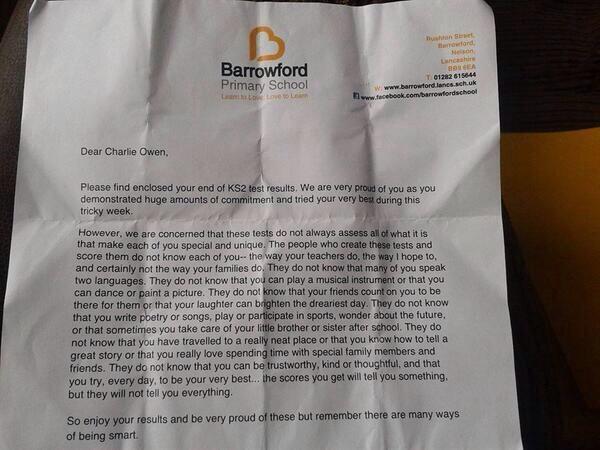
Many people have lauded the school and its approach. But let’s look a little closer.
This letter is from a primary school, and the exams the student took were apparently for Key Stage 2. According to Wikipedia, this stage assesses students in the age of 7 – 11.
I personally have a problem with this. I understand the need to ensure students progress academically. But formal exams for 7 year olds? At what stage did we give up on childhood and adapt a utilitarian approach in all we do? Maybe the children can get a day off occasionally to clean a chimney somewhere?
We rely on tests too much. The education systems in England and Ireland seem to cry out for some sort of standardised assessment that will ensure the teachers are doing their job, and that we can measure students’ progress.
We have bought into a culture where our children are valued based on what they achieve. Play for the sake of play is getting rarer and rarer. You like sport? Join a team and train a few nights a week. You like dancing, finish each term with a competition, where you may or may not EARN a medal. And we, as parents, join in.
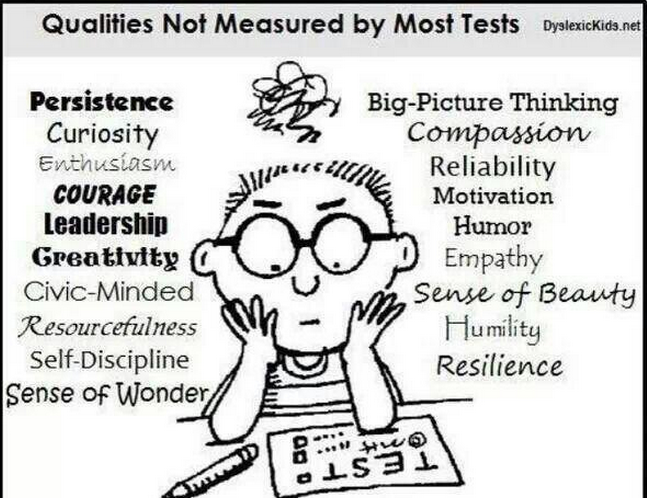
We miss the whole point that our kids have, each of them, unique and wonderful characteristics. By excessively tying them down to a narrow focus, we risk blocking out a whole range of their creativity, their personality.
I like the image below:
Image from: http://www.edudemic.com/19-qualities-measured-tests/
So in the month and week following the release of the Leaving Certificate and Junior Certificate results respectively, we could do with looking at what we are actually doing to our children.
If we follow the English model, we will end up examining children from the age of 7, and keep this up until after they finish college.
This is punishing on all concerned: the student who may not achieve the results that others think he/she should; the parents worried that results should be better; and the teachers who worry about their own assessments.
In the year ahead the teacher unions in Ireland are going to challenge the Department of Education and Skills over the issue of assessment in the new Junior Cycle School Award. Particularly contentious is the issue of in-school assessment. Who does the assessment, and how is the assessing standardised. (Who assesses the assessors?)
We need to open a very, very wide discussion on where we are going with education in Ireland. Ultimately, what is the point of education, and what, really, are our aims at the different stages of childrens’ development. And, of course, will we put the proper resources in place in order to ensure the best outcome (to use the lingo) for the whole education system.
 John Hurley