On Stubbing a Toe and Grief

Anyone who has ever stubbed their toe off of a sharp corner knows this simple truth:

There is a big difference between describing a stubbed toe, and the real experience of having stubbed a toe.

And so it is with grief.

If we (hopefully) live long enough, we will all have to deal with the awful reality of grief. The reality of knowing the loss of someone who we have loved, of someone who was an important part of our lives.

To date, I have had to face this reality on three occasions.

In June 1995 I was at home and my mam complained about pins and needles in her legs. She tried a few things – one of which was a hot bath to ease her muscles. Nothing worked, and when dad came home he took her straight to the doctor.

The doctor, to his credit, saw mam trying to get out of the car and told them to go straight to hospital. The initial diagnosis that Friday evening was of a stroke. However, on Monday evening a more thorough scan and diagnosis gave us the terrible news that mam had a brain tumour, inoperable. In the space of a few days we went from mam being healthy to her being told she was going to die.

The next months were a whirlwind, a blur. We chased every theory and quack in the vain hope of something that would hold back the tide, that would deny the inevitable, that would save her life.

Part of that journey was a pilgrimage to Lourdes.

Mam travelled to Lourdes in search of a cure, but that’s not what she received – she went there on a wheelchair, and came back on a stretcher. Instead there was a different type of cure.

You see, up until that point our house was focused on fighting the cancer – on pushing back. After Lourdes our house became a place to make mam comfortable, it became a place where we had accepted her ultimate diagnosis, and now aimed to preserve her dignity and her peace.

Lourdes did provide a type of cure – just not the type that we had anticipated.

On 15th September mam died. Hard to believe that that is now almost 30 years ago.

In the following years we, each of us, tried to deal with the grief in our own different ways. As is common with children who have lost a parent, we feared for dad.

I have a clear memory of one day being at a choral event in Cork and seeing a woman who had similar hair and dress style as mam. I was left breathless with the shock and reviving of her memory.

Weirdly, this is the natural way of things. If we are lucky, we get to bury our parents. There is something wrong with the world if it’s the other way around.

In 2018 it was the other way around.

On a cold February morning we got the terrible news that the body of my younger brother had been found – he had died of a heart attack.

Unlike mam’s death 23 years earlier, we had no warning, no time to prepare. Finbar was, it seemed, fit and healthy. He was only 46 and full of life.

I can honestly say that it was a full 2 years before I “got over” his death. In reality I never fully got over it, and thinking about the unfairness of such an early death will still make me angry and cry. Simply put – I still miss my brother, he was cool.

Grief is complex, deep, and varied. We use a lot of different theories and analogies to explain it, but the simple fact is that it hurts. A lot.

I regularly refer to the Kubler-Ross stages of Grief. It provides a framework that allows us to understand some of what we’re going through. (And yes, I know that some have questions around how accurate the stages are)

Source: https://www.sandstonecare.com/blog/stages-of-grief/

In 2023 my dad died at the age of 92. His death brought more of an existential aspect to grief. Both of my parents are now gone, along with my younger brother. This kind of thing really makes you think about your own morality.

Dad’s death and Finbar’s have affected me in totally different ways. While Finbar was in apparent full health, dad had suffered in his final years. In a way, I grieved the man I knew as my father as he faded in front of me.

When supporting someone who is grieving, perspective is important. Just because I have been through grief does not mean I truly get what another person is going through now. I’m describing a stubbed toe to someone who has just suffered from a stubbed toe.

Unlike a stubbed toe, however, grief takes a very long time to process. This is not something that can be rushed or forced. Our feelings are our feelings, no matter how inconvenient.

To contradict the poet – sometimes you do need to go gentle.

If you are dealing with grief talk to someone, and allow the myriad of emotions to happen. Sometimes it’s OK to not be OK.

A final note – this reading of Dylan Thomas’ “Do Not Go Gentle” is incredible. Take a moment for yourself, and do be gentle with yourself.

One Year On

This day last year we got the news that my younger brother, Finbar, had died suddenly.

I was at work when I got the phone call, and rushed home to see what had happened. Arriving at his home to find two guards and my sister in law waiting. Other family and friends arriving, in shock and in tears.

Finbar had died peacefully, though it took until June before the coroner’s report came back that it was a heart attack that killed him. At the time there was some comfort in that. There still is.

The rest of the day was a blur. Phoning the rest of our family to let them know. Gathering at the table to figure out what to do next. Food and lots of tea appearing by the magic and grace of wonderful neighbours and friends.

The next three days were more of a blur. Preparing for the dreaded funeral, whilst at the same time trying to make sure it would be a fitting tribute to the life and character of Finbar. Getting friends, family and neighbours involved in the mass. The ceremony itself went well, with a huge turnout, and lots of people gathered to celebrate the life of Fin.

But time passed, and we moved into the period after the funeral.

Following the Month Mind mass things changed. Now that the frenzy, the busyness of the funeral was over, we had to adjust to life without Fin.

I sometimes think that things were a bit easier in a different era. A time when there was an official period of mourning, and a person could visibly display or wear the uniform of grief.

There are times over the past year I could have done with that…
“How are you?”
“Fine.”
Yeah.

The thing is, we often expect people to be fine. To be OK.
A friend of mine had a great phrase based on one of the self-help books from the 80’s. “I’m OK, You’re OK.”
His take on it? “I’m not OK, You’re not OK, but THAT’s OK.”
That’s an important message. It’s OK to not be OK sometimes.

There are definitely plenty of times over the past year that I’ve not been OK.
Times when the loss of Finbar has struck more than others.
Times when I’ve cried for no discernible reason.

But today.
The simple fact that it’s one year today that we found out.
Today is a day that will stand out for years to come.
Maybe today, and the anniversary next Sunday, will be the start of a greater healing.

As a post script, if you are ever in a position where you would like to help another, take into account a great bit of advice I received once.
We normally say something along the lines of “If there’s anything I can do, let me know”
In reality, a bereaved person often feels powerless, and is unable to ask for help, or unsure of what to ask.
A more powerful way to help is to offer something solid. “I’ll look after the kids for a day”, “I’ll cook dinner”, “Take the afternoon off, I’ll cover”
Something, anything.

Finbar on a fishing trip to Knockadoon.
I only realised later that this photo was taken on mam’s anniversary, 15th September.

Through The Cracks

There has been a lot of talk in the media over the past few days about the crisis in the health system in Ireland.  Things are pretty grim.

According to the Irish Examiner, waiting lists have soared 968%.  In other words, if you are on a waiting list, you wait almost 10 times as long now to be seen.

And this is scary.  But it is not the full picture.

As a culture we are still hesitant to discuss mental health. As a result, we don’t get the full picture of the difficulties faced by so many people in crisis.

According to Aware, up to 10% of young people suffer from depression at any one time (my emphasis)

According to this document from the CSO, in 2005/2006 there were 335,134 students in second level education (see p.115)

If we put these numbers together, you have approximately 35,000 second level students suffering from depression at any given time.  I find this a very upsetting statistic.  Not just for the fact of the depression that the students are battling, but for the fact that we have so few resources to help the students in need.

Schools themselves have limited resources.  In an incredibly callous display of disregard for students, our former minister, Rurai Quinn removed guidance counsellors from schools.  (It remains to be seen whether our new minister, Jan O’Sullivan will reverse this decision)

I don’t want to give the impression that schools should be the place to fix these issues.  A school’s function is to educate students.  Schools are not places to treat issues around mental health, just as schools are not places to treat broken bones or other physical ailments.  Schools can run programmes to promote mental health, but if you’re sick – then you need a doctor.

However, just as schools can provide support for students with broken bones and other physical ailments, they are also places that can provide support for those in pain.

Or at least they could if they had the resources in place.  With all the staff cutbacks (especially that to guidance counsellors) schools are hard pressed to do all that is expected of them.

No.

More is needed in supporting our teenagers in trouble.

We do have some excellent groups in Ireland, for example:

  • Aware is working to help those suffering from depression.
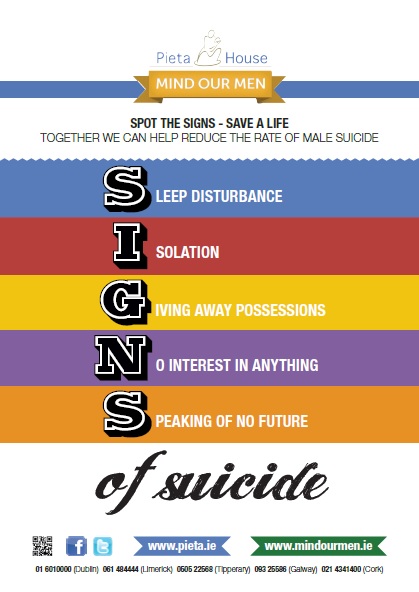
  • Pieta House works to help those who are suffering from suicidal thoughts or deliberate self harm
  • Console helps those suffering, either because they are thinking of suicide, or because someone close to them has died by suicide.

But our health system is not able to cope.  We don’t have enough psychiatric beds to help those in serious pain.  Our social workers are understaffed and overworked.  Counselling via the health service has a huge waiting list.

In short, our mental health services are not serving our teenagers effectively.

It’s not just the teenagers who are left fall through the cracks.

In this article the Irish Times highlights that 554 people in Ireland died from suicide in 2011.  We all know families who have been devastated by the loss of someone they love.

As a society we need to do a lot more to look out for those around us.  We need to do a lot more to look out for those who fall through the cracks.

SIGNSnobleeds