Our national forestry agency (Coillte) spends about €450,000 each year cleaning up domestic rubbish from our forests.
Why would anyone do this?
Evening Echo feature: Meet the man on the frontline of the war on dumpers
Reply
Our national forestry agency (Coillte) spends about €450,000 each year cleaning up domestic rubbish from our forests.
Why would anyone do this?
There has been a lot of talk in the media over the past few days about the crisis in the health system in Ireland. Things are pretty grim.
According to the Irish Examiner, waiting lists have soared 968%. In other words, if you are on a waiting list, you wait almost 10 times as long now to be seen.
And this is scary. But it is not the full picture.
As a culture we are still hesitant to discuss mental health. As a result, we don’t get the full picture of the difficulties faced by so many people in crisis.
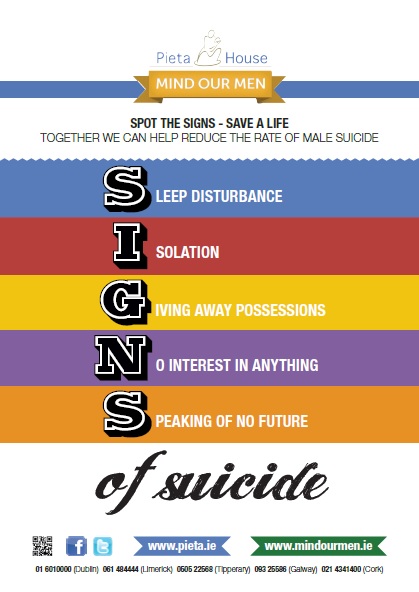
According to Aware, up to 10% of young people suffer from depression at any one time (my emphasis)
According to this document from the CSO, in 2005/2006 there were 335,134 students in second level education (see p.115)
If we put these numbers together, you have approximately 35,000 second level students suffering from depression at any given time. I find this a very upsetting statistic. Not just for the fact of the depression that the students are battling, but for the fact that we have so few resources to help the students in need.
Schools themselves have limited resources. In an incredibly callous display of disregard for students, our former minister, Rurai Quinn removed guidance counsellors from schools. (It remains to be seen whether our new minister, Jan O’Sullivan will reverse this decision)
I don’t want to give the impression that schools should be the place to fix these issues. A school’s function is to educate students. Schools are not places to treat issues around mental health, just as schools are not places to treat broken bones or other physical ailments. Schools can run programmes to promote mental health, but if you’re sick – then you need a doctor.
However, just as schools can provide support for students with broken bones and other physical ailments, they are also places that can provide support for those in pain.
Or at least they could if they had the resources in place. With all the staff cutbacks (especially that to guidance counsellors) schools are hard pressed to do all that is expected of them.
No.
More is needed in supporting our teenagers in trouble.
We do have some excellent groups in Ireland, for example:
But our health system is not able to cope. We don’t have enough psychiatric beds to help those in serious pain. Our social workers are understaffed and overworked. Counselling via the health service has a huge waiting list.
In short, our mental health services are not serving our teenagers effectively.
It’s not just the teenagers who are left fall through the cracks.
In this article the Irish Times highlights that 554 people in Ireland died from suicide in 2011. We all know families who have been devastated by the loss of someone they love.
As a society we need to do a lot more to look out for those around us. We need to do a lot more to look out for those who fall through the cracks.
Interesting comparison on the choices in tech in the classroom.
It’s a question you will often hear debated when schools look to buy new devices. iPads? Macs? PCs? Chromebooks? Which is best? The short answer is, it depends. None of them are bad devices, at least not any more, so it usually comes down to what is the best fit for students, teachers, and the ways that a school is looking to advance teaching and learning with technology.
For this post, I joined forces with Stephen Lai, from teachingwithipad.org. Together we compiled some of the more popular advantages and disadvantages associated with using an iPad when compared to a Mac or Windows laptop.
Why iPads?
1. Speed – We have all become accustomed to how fast our iOS devices wake from sleep. They rarely need powered off and the instant on gratification you get is hard to beat. In fact, if your laptop doesn’t have an SSD drive, the iPad will beat it…
View original post 1,059 more words
Just introducing Google Classroom in our school. Not just the tech that’s interesting – it’s how it changes your workflow and interactions with students.
I’m starting to sense a bit of a mancrush between Google Classroom and myself. It just seems really easy to use and I’m loving how it can start to change how we communicate with kids, assign work, start conversation, share resources. It can keep all of your kids and all of their stuff in one place while giving you the ability to quickly get and send things between yourself and your students.
Google Classroom is available to schools and districts with a Google Apps for Education (GAFE) domain so if you’re in a school that hasn’t jumped on that bandwagon yet, well . . . you’re gonna have to in order to use Classroom.
You can obviously use Classroom for lots of things such as creating a lesson with multiple documents, multimedia, and links. You can use it as a quick and easy way for students to turn in their…
View original post 504 more words
Time is a very strange thing.
It is now 19 years since my mother died. Sometimes I have trouble remembering things that happened yesterday, or even this morning, yet I remember that morning in September 1995 with crystal clarity.
As I wrote before, my mam died of a brain tumor that was brutally, and, perhaps mercifully, quick. But something that has been in my memory a lot recently is something that happened about a month into the illness.
After mam’s diagnosis our house was bedlam, as you might expect. We were trying to deal with the physical needs of a person who was terminally ill. At the same time, speaking for myself, I was denying the terminal part of that statement. We sought cures everywhere.
We went to herbalists, we spend a wad of money on capsules containing shark cartilage, we called in every quack you could think of. In short, we prayed for a miracle.
And then mam had a chance to go to Lourdes.
It was something that she had thought about for a long time before she got sick. And such a pity that it was only in the midst of illness that she actually got to go.
Mam went to Lourdes with my dad and my sister. Up to that point our house was a place of heightened emotions. It was a place where we were trying to fight an illness. The word ‘fight’ brings with it certain overtones. Words like ‘anger’, ‘aggression’ and ‘violence’ come to mind. And yet it wasn’t that kind of fight.
Nevertheless, a certain atmosphere did pervade our house for that first month.
And them mam went to Lourdes.
Many of us associate Lourdes with healing. People go there praying for miracles. People go hoping for healing. People go there hoping for a great many things.
Mam did not heal physically in Lourdes. She travelled there in a wheelchair, she came home on a stretcher.
No physical cure then, but something did change. And I didn’t spot it until much later.
After mam, dad and Monica came home, the atmosphere in our house was very different. I have no memory of fighting the cancer at that point. The focus now became one of making mam as comfortable as possible; of making our home a place of welcome for the very many visitors that we had.
Whatever people say about Lourdes, I believe that something happened there. There was a cure, but not the one we hoped for. The cure was within each of us. We were given the strength, the grace, the courage to endure the next few months and years.
For that, I am grateful.
You’ve probably all seen it this Summer. The letter from Barrowford Primary School to a student where the school sets out to reassure the student that his results only reflected a small aspect of who his is.
Here’s the letter in full:
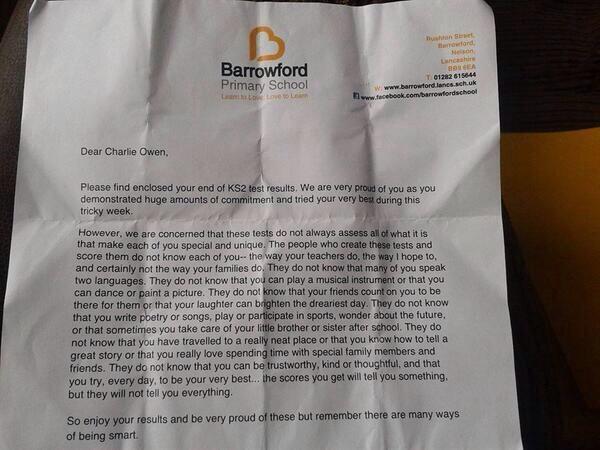
Many people have lauded the school and its approach. But let’s look a little closer.
This letter is from a primary school, and the exams the student took were apparently for Key Stage 2. According to Wikipedia, this stage assesses students in the age of 7 – 11.
I personally have a problem with this. I understand the need to ensure students progress academically. But formal exams for 7 year olds? At what stage did we give up on childhood and adapt a utilitarian approach in all we do? Maybe the children can get a day off occasionally to clean a chimney somewhere?
We rely on tests too much. The education systems in England and Ireland seem to cry out for some sort of standardised assessment that will ensure the teachers are doing their job, and that we can measure students’ progress.
We have bought into a culture where our children are valued based on what they achieve. Play for the sake of play is getting rarer and rarer. You like sport? Join a team and train a few nights a week. You like dancing, finish each term with a competition, where you may or may not EARN a medal. And we, as parents, join in.
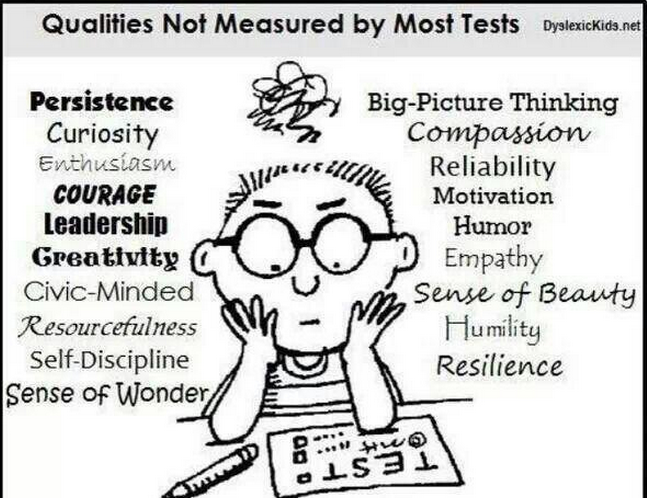
We miss the whole point that our kids have, each of them, unique and wonderful characteristics. By excessively tying them down to a narrow focus, we risk blocking out a whole range of their creativity, their personality.
I like the image below:
Image from: http://www.edudemic.com/19-qualities-measured-tests/
So in the month and week following the release of the Leaving Certificate and Junior Certificate results respectively, we could do with looking at what we are actually doing to our children.
If we follow the English model, we will end up examining children from the age of 7, and keep this up until after they finish college.
This is punishing on all concerned: the student who may not achieve the results that others think he/she should; the parents worried that results should be better; and the teachers who worry about their own assessments.
In the year ahead the teacher unions in Ireland are going to challenge the Department of Education and Skills over the issue of assessment in the new Junior Cycle School Award. Particularly contentious is the issue of in-school assessment. Who does the assessment, and how is the assessing standardised. (Who assesses the assessors?)
We need to open a very, very wide discussion on where we are going with education in Ireland. Ultimately, what is the point of education, and what, really, are our aims at the different stages of childrens’ development. And, of course, will we put the proper resources in place in order to ensure the best outcome (to use the lingo) for the whole education system.
Sometimes you just have to wonder what people are thinking when they talk about teenagers and what they get up to in schools.
In this article in the Avondhu newspaper in Fermoy from August 28th, it seems that a formor local councilor thinks that some arson attacks in the area will be solved once students get back to school.
“Maybe it’s because the schools are on holidays” he says. Really, Cllr O’Donovan? Just what does he think happens within the four walls of a school? What does he actually think of young people?
Does he perhaps worry that teachers and other staff need stab-vests in school? Is he hoping that we will install metal detectors and security guards? Maybe the poor man has been watching too much dodgy telly.
It’s also possible that he hasn’t seen the inside of a school in a very long time and just doesn’t know what a challenging, interesting and rewarding place a school is.
No two days are the same, no two class groups are the same. And just as the philosophers debated if the same river passes under a bridge, the group you meet today could generate a totally different dynamic tomorrow.
Schools are great places to be. The chance to see students learn, develop, mature and go on to college or other walks of life is hugely satisfying. And this all happens in the 21st century, not in some kind of Dickensian workhouse.
So whatever our formerly honourable councillor was thinking, he was being thoroughly unfair to students and schools.
Utterances like this make me think it’s just as well that some of the councils were abolished this year.
 Katie Piper’s new book.
Some years ago I came across a documentary about Katie Piper who was brutally raped by her ex-boyfriend and then had sulphuric acid thrown at her by his accomplice, leaving her with a terrible facial disfigurement.
I was appalled by the double attack on Katie and her bravery in dealing with the aftermath of her physical injuries. One particular scene in Katie Piper: My Beautiful Face brought the tragedy home because it resonated so deeply with me. Katie and her mother (I think) were walking to the local shop for the first time since the accident, not an easy task for a girl whose beautiful face had been severely damaged, and who was naturally fearful at how others would respond in a world that is often unforgiving to those who look different. Stepping into the outside world where people can stare, point and comment on your…
View original post 582 more words
We all know the trick. The magician gets you to look at his hand, the coin disappears only to reappear later somewhere you least expect it.
For days we agonised over the contents of the ‘humanitarian’ convey about to enter the Ukraine. All our eyes were on it, guns or food? Guns or food? And then the master craftsman, the genius of deception, moves (or didn’t) his forces into the very south of the Ukraine, opening another front in this ever more volatile war.
Putin is a bit of a genius. One has to admire his ability to deceive, to distract, and now to deploy. For months he has peppered special forces into the Ukraine, and the west has been pretty silent. Initially it was a big gamble, Putin calculated that the West, especially America, would be pretty silent.
Why would he think this? Well, president Bashar-al-assad managed to get away with murder (literally) this time last year. Despite talks of ‘a line in the sand’, nothing of consequence really happened. Bashar-al-Assad is still in power, no-one has ever stood trial for the chemical attack outside Damascus last year.
For months now Putin has been behind a steady stream of Russian troops and equipment into the Ukraine. A friend of mine is originally from one of the areas currently in the middle of the fighting. His mother still lives there, and provides some very interesting information.
They live about 30 KM from the Russian border, and at about 4 AM many mornings the tanks and equipment begin to pass. Local people do not know any of the pro-Russian fighters. Recently, a trolleybus was run over by a tank. Another day she saw a bus swerve into a bush so as to avoid an armoured column. And the tanks in that column were all freshly painted.
At this stage it’s hard to guess what Putin’s end game is. But it is certain that he’s not going to back down. Hard to believe, but for the first time in a long time, a Russian/Soviet leader has uttered the threat of nuclear weapons.
God help us all.
In the meantime the master-illusionist has his home audience dazzled and eating out of his hand. One of the big newspapers in Russia is Pravda. Look at it’s homepage and you will see articles such as ‘Ukraine prepares to steal Russian Gas Legally’, ‘USA or United Totalitarian Police States‘, or (cruelly) ‘James Foley Execution Video Hoax?’
And what will the West do to oppose him? Against a fast-moving army, our politicians spend days talking about sanctions. More needs to be done, lest more people die as pawns in his game.
<Note: Pravda accessed online 30/08/2014>
Take time to read this piece by Donal O’Keeffe.



 John Hurley