Striking Again?

I reckon Minister Jan O’Sullivan is beginning to think that us teachers are an ungrateful lot.  She’s in the job less than a year, and we’re heading towards our second strike.  Why?

Well that’s the core question.  Why should we go on strike again?  Why not just accept what the minister referred to yesterday as her ‘fair and reasonable compromise’?

Let’s take the question a step further.  Why go on strike when so many schools already had a day off yesterday?  At least that’s what this tweet suggests:
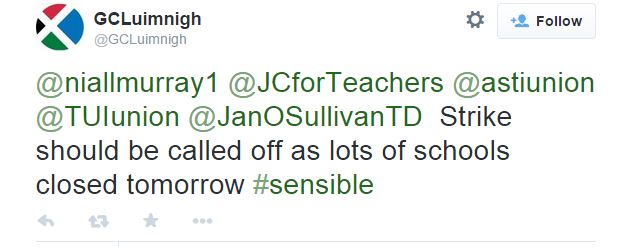
tweet

So there you have it.  The strike is about having a day off.

Seriously?

There is one core principle at stake in this strike.  That of assessment.  In Ireland the final assessment of a student’s grade is absolutely impartial.  It is a core value of our system.  And our government wants to squander this in a money saving exercise.  (more on that later)

Our state examination system is one of the few things in this country that we can truly say is impartial.  Money can’t buy grades or favours in the system.  When an examiner starts reading scripts, the only identification he or she will get is the exam centre number, and the candidate number.  Race, Gender, Ethnicity, Wealth, Sexuality or even Behaviour are not factors when it comes to having your exam corrected.

The same could not be said of a teacher correcting his or her own students’ work.  All of us teachers are human.  Any of us can end up liking one student over another for the simplest or stupidest of reasons.  And this could affect that student’s grade.

Let’s talk about the money.

At our first strike I was asked if this was about pay.  Would teachers accept the change if more pay was offered?  It was a fair question, and I probably didn’t give the best answer at the time.  But I’ve had time to think about it.

The strike isn’t about pay – but resources are part of the picture.

Schools, have suffered a brutal regime of cutbacks in the past six years, and our most recent budget had even more cutbacks in store.

  1. Remove Guidance Counsellors from secondary schools
  2. Increase the pupil/teacher ratio
  3. Cut capitation grants to schools
  4. Again, cut capitation grants to schools (and again for next year)
  5. Reduce supports for students with Special Educational Needs

Supports for students are constantly being cut.  Resources are being cut.  Student welfare is being cut.  And in the middle of all this the minister is trying to sell us a flawed product.  And she is trying to sell us something when our resources are being decimated.

The new Junior Cycle Programme is flawed.

One of the sad things about this situation is that the unions and the National Council for Curricular Awards (NCCA) had agreed a new Junior Cert in 2011.  All this trouble could have been avoided.

However, even if the Minister accepts our principle that teachers should not correct their own students’ work, and proceeds ahead with a productive vision of a new Junior Cycle, then she would then need to provide the proper resources to implement it.

The Junior Cert is flawed.  It does need to be revised, rebuilt.  But it needs to be done properly.  The current programme is not the way forward.

And that is why we teachers will again go on strike next week.

Next week I will stand proudly with my colleagues and we will make our opposition to the minister’s plans known.


More articles on the New Junior Cert:

The New Junior Cert

I don’t want to go on strike.  I need to go on strike.

Now you see it…

The Narrow Focus of Assessment

Education and Equality

6 Reasons why we’re going on strike
 

Getting Started in Google Classroom

One of the tools available in the Google Apps For Education (GAFE) suite is Google classroom.  It gives the teacher the ability to set assignments, allows students to return assignments, and facilitates teachers’ engagement with students as they complete their assignments.

So.  How to get started with this?

If you are a teacher in a school / Institution using GAFE, then you need the administrator to register you as a ‘classroom-teacher’.

Next, go to classroom.google.com and sign in with your GAFE account

Once you are logged in, you will get a home page that will show all the classes you have created (but that’s a step or two later)

First, how to create a classgroup:

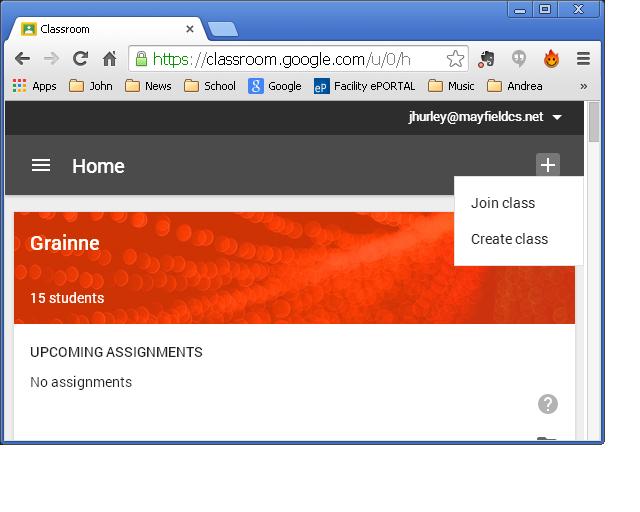
On your homescreen, near the top at the right hand side, you will see a + sign.  Click on this, and you should see a drop-down menu like the one here:

classroom1

Click on the ‘Create Class’ option.

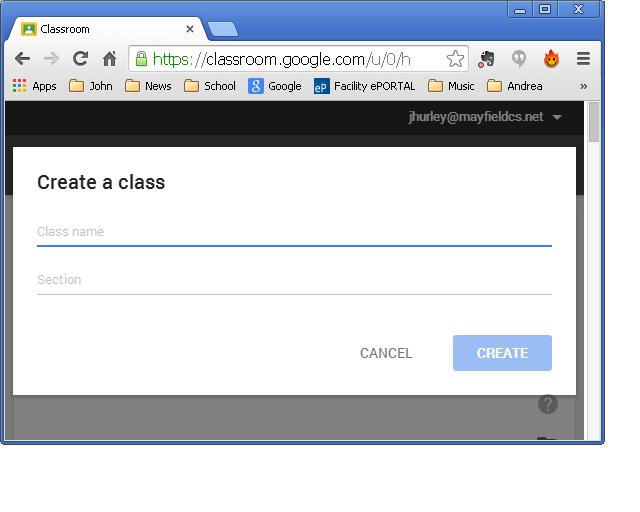
That will give you this screen:

classroom 2

Give your shiny new class a name (and a section if you’re doing just one part of a course)

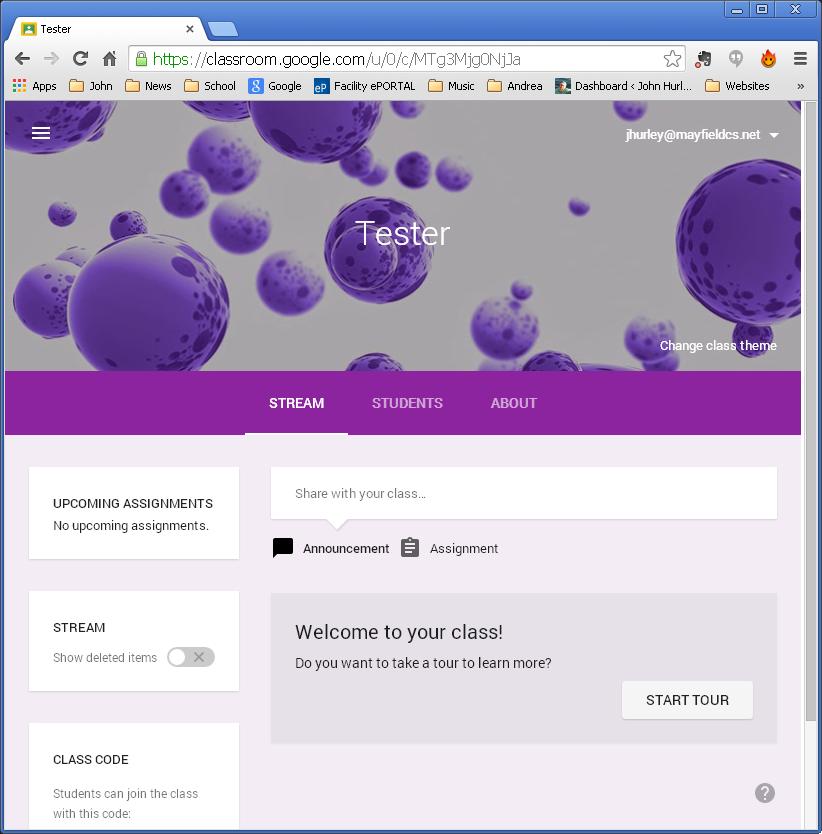
Once you click ‘Create’ you will be taken to this or a screen like it:

classroom 3

At this point you can take the (brief) tour offered at the bottom right-hand-side of the page, or you can dive in and add students to the class.

Here, you have two options:

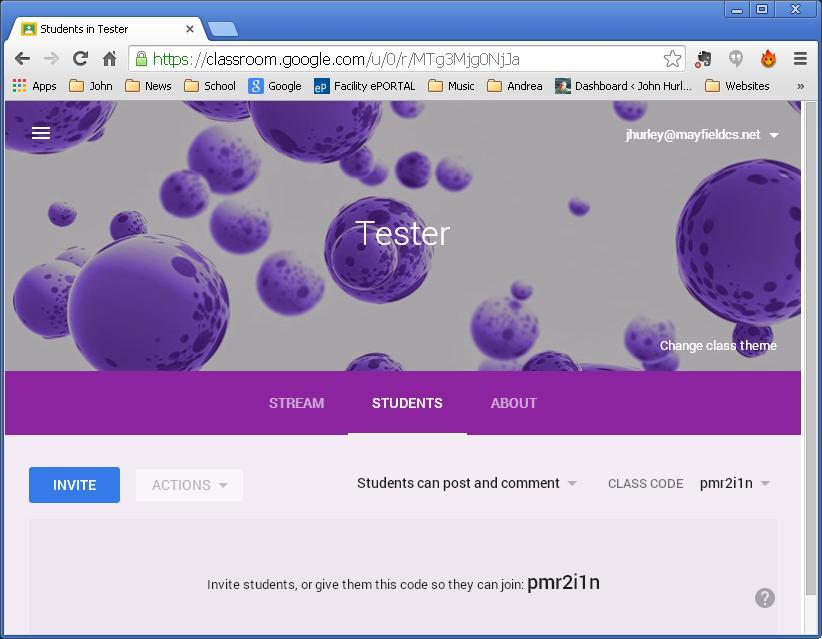
  1. Give students the class code (listed at the bottom right of the page).  The students then log into their google account, go to classroom.google.com and type in the code.
  2. Invite students manually

To invite students manually, click on the ‘Students’ tab in the top centre part of the page.

Classroom 4

Click on the nice, blue ‘Invite’ button and you will get this option:

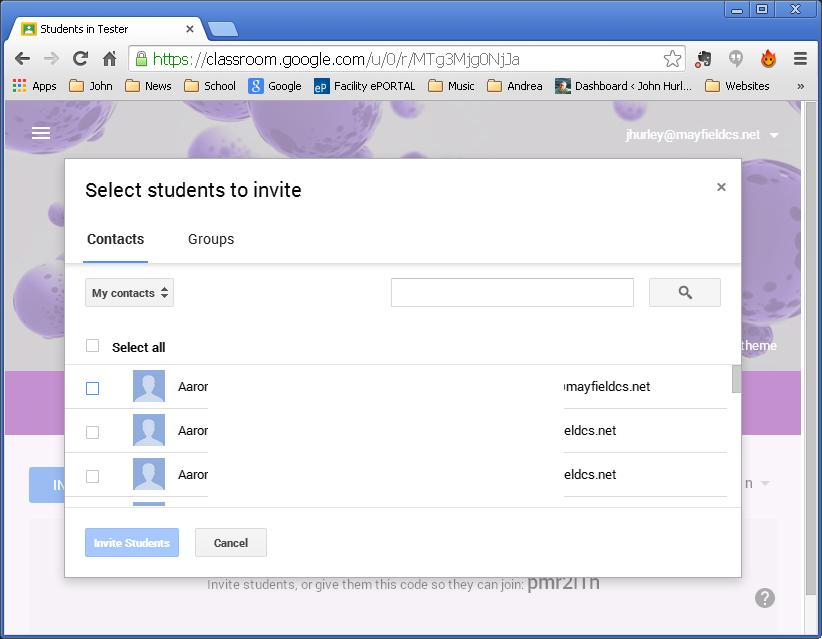
Classroom 5

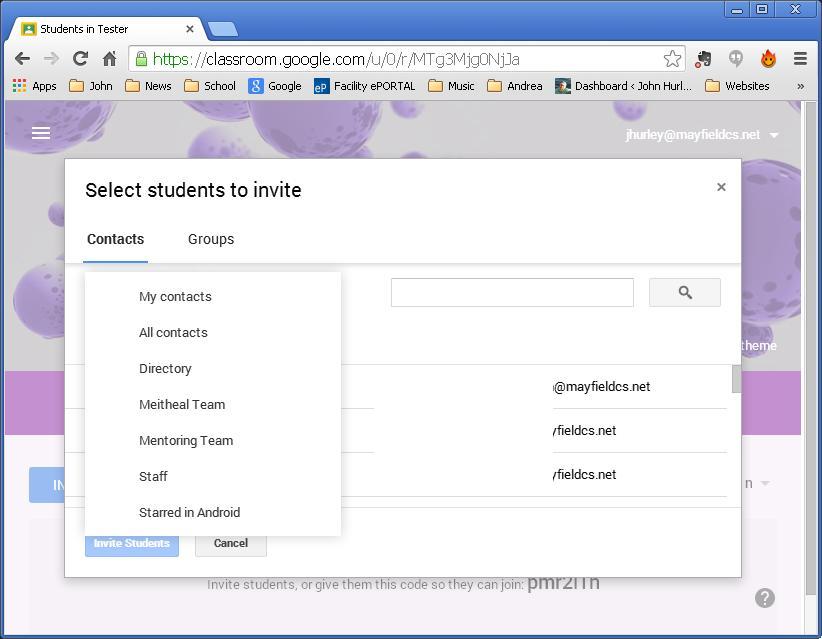
The system will first give you the option of inviting students in your own contacts list.  This is actually limited unless you already have the students’ email address.  You need to click on the ‘My contacts’ button, and then click on ‘Directory’.  This will give you the directory of all the users with an account in your school (domain)

Classroom 6

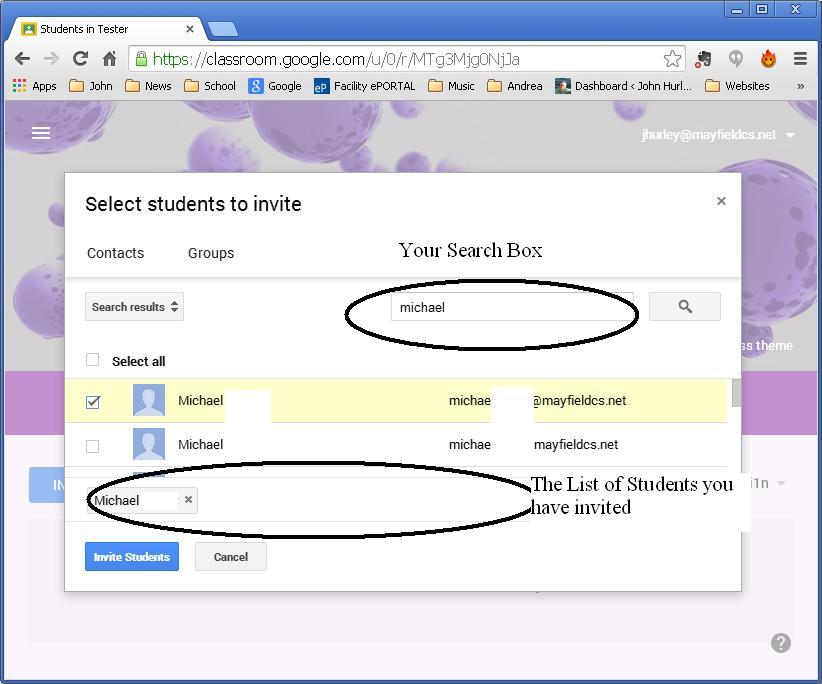
The hard part now is to actually add students from the directory in the most economical way possible!

Here’s what works for me:

  1. Have your roll handy
  2. Type the first name of a student into the search box
  3. You will be shown all the students with that first name
  4. Tick the check-box beside his/her name
  5. Once his/her name appears in the box below, type in the name of the next student
  6. Repeat until you have all your students included
  7. At this point click on the ‘Invite Students’ button
  8. The students will now receive an email inviting them to join your class group
  9. They need to click the longer link in the email.
  10. This will bring them to their classroom account, and they will then need to accept your invitation.

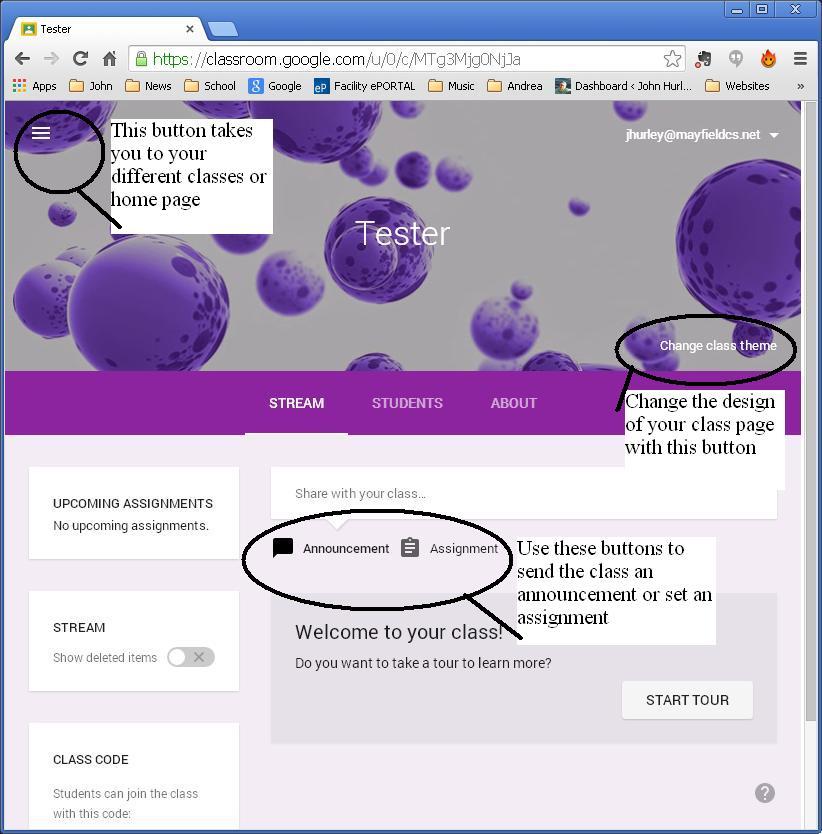
Classroom 7


There are extra options at this point.  You can click on the ‘About’ button for your class group to set more information (your choice!)

Classroom 8

Good luck!

If you are already using Classroom and have tips, ideas or more suggestions – I’d love to hear them!

Related Posts:

Sharing Documents in Google Drive

Getting Started in Google Drive

Google in School

7 Ways to use Google Classroom

I don’t want to go on strike. I need to go on strike.

Some of our students are very clued in.  On Friday one of my leaving certs approached me with his phone and gave me the news of the upcoming strike.  Good for him.  He’s interested in what’s going on in the world.

And yet he represents one of the many students who I will walk out on, come December 2nd.  He’s a great guy, his classmates are great, and I’m sure this is replicated across the country, and yet here we are.  We, the members of the two secondary school unions have voted for strike.  Here’s the joint statement from the unions.

So.  Why are we going on strike?

There is one core issue.  Assessment.

You see, up until now the Junior Cert has been assessed externally.  This is important because it means that little Johnny from Mayfield is on the same playing field as Alistair from D4.  It’s an incredible logistic feat, but when a student sits a state exam, their paper goes to a different part of the country, and the examiner knows nothing – nothing about that student.  This is a vital part of the integrity of the system.

In his time as Minister for Education, Ruairi Quinn wanted to do away with this and replace the Junior Cert with the JCSA and have it assessed in-house.  This was a sea change and, if accepted, open to abuse.  A JCSA certificate from my community school would not carry the same prestige as one from an up-market fee-paying school.

Our new Minister, Jan O’Sullivan has tried to reach a compromise in this.  She has offered 40% internal assessment, with an oversight element.  This is still not good enough.  For a number of reasons:

  1. We have still broken from the principle of external assessment for the exams.  This would still mean teachers marking their own students work.  Who is to say that this isn’t open to abuse or manipulation?  What pressures will be brought to bear on some teachers to bring up the marks of their students?
  2. The syllabus is due to change.  And where are the resources to implement a new syllabus?  Syllabus change and development is necessary.  I think that all teachers accept that we need a revision of the Junior Cert.  In fact, we had agreed to this in 2011, and had a plan in place.  But any change of this magnitude needs proper resources.  Teachers need training, updating in their skills.
  3. Building a project for assessment.  Have you ever tried to get 25 students to complete a project?  It can be… interesting.  There is a balance to be struck between driving the students and spoon-feeding them all the answers.
  4. Time.  When is the marking of this 40% due to happen?  A teacher with 33 class periods in a week is already struggling with time pressures.   If that teacher has students sitting the state exam, then he/she ends up having to correct the work for the state in an unpaid manner.
  5. Where is the educational merit of the decision?  Why does the minister not want to move on the 40% number?  Money.  The less work that is corrected by the State Examinations Commission (SEC), the better.  It saves money.  In it’s original form, the JCSA appeared to be a precursor to phasing out the SEC.

Look at some of what’s been done (in the name of educational reform)

  1. Remove Guidance Counsellors from secondary schools
  2. Increase the pupil/teacher ratio
  3. Cut capitation grants to schools
  4. Again, cut capitation grants to schools (and again for next year)
  5. Reduce supports for students with Special Educational Needs

I’m being a bit long-winded, so back the core issue.  Why are we going on strike?  Because teachers should not assess their own students for a state exam.  Add to that, (speaking for myself) I don’t trust the motivations behind these measures.

So. It’s time to act.  It’s time to let the Minister and her government know that enough is enough.  Education has been attacked long enough.  I don’t want to go on strike, but I need to.

Sharing Documents in Google Drive

(I’m building a Google site in our school domain to put together a series of ‘how-to’ pages to help students & staff figure things out.  Here’s the latest offering, hope it helps someone!)


Once you know how to create documents, it’s a good idea to know how to share information.

For example, you may be part of a group working on a project.  Drive makes it very easy to share whatever document you are working on.

First Method for Sharing:

Let’s take the document we created earlier as an example.  Remember, it looks like this:

Open a document for yourself.

Notice that at the top right hand side of the document there is a blue button labelled ‘Share’.
Click on this.
You will then see a pop up screen that looks like this:

Type the email address of whoever you want to share the document with.  Make sure you have the right email addresses!

If you have accidentally clicked on the sharing button click ‘Done’, and you will exit this screen.

Once you have the names you want to share with, you can choose to add a note.

Click the ‘Done‘ button at the bottom of the pop-up window and that’s it.  You have now shared the document with your group.

It will appear in their Drive folder.

Second Method for Sharing

In your Drive folder, look at the list of documents you have.

Click once on the document you want to share.

You will notice that the menu bar on your screen now has a few new options.  They look like this:

Click on the icon that looks like a person with a + sign on their shoulder.

You will then get the sharing screen that you saw in Method 1

Follow the same instructions, and you have managed to share!

How Do I See Something Shared With Me?

Open your Drive folder.  At the left hand side you will see a tab labelled ‘Incoming’ (in the ‘New Drive’.  In the older version of drive, it’s called ‘Shared With Me’

Click on this and it will show any documents shared with you.

Just what are schools for?

It’s the kind of question that can get you thinking.

Depending on who’s standing on a soapbox, you could be led to think that schools are responsible for any number of different, and possibly contradictory, functions.

  • Schools should prepare students for science
  • Schools should prepare students for business
  • Schools should prepare students for the world of work
  • Schools should prepare students for the arts

and so on.

In the midst of all of this there is the juggernaut of assessment.  The cycle of PISA brings panic and hysteria to departments and newsrooms as whole countries try to reassess how they are doing in competition with their neighbours.

I have previously stated my reservations around the Narrow Focus on Assessment, but for a better reply to PISA than I could ever write, have a look at this piece written in the Guardian.

But schools are, I  believe, more than just about turning out utilitarian units destined to be productive members of the business community or of industry.

I think that the piece of Irish Legislation dealing with the running of schools (The Education Act, 1998) actually gives a good idea of what schools can be.  In Section 9, (d) the Act states that schools shall “promote the moral, spiritual, social and personal development of students, and provide health education for them

That really opens it up.

The children we take into schools will one day leave as adults ready to take their place in the world.

Yes, some will go on to be business leaders, and yes, some will go on to be innovators, entrepreneurs, productive employees.

But not all of them.

There will also students who will not find a job, there will be the students who may be too ill, or have too great a disability to work.

The students who leave our schools will go on to become parents, friends and neighbours.  They will be members of communities and clubs, they will be a part of society.  And how do our schools serve them?

Schools are not something that are separate, where students are trained.  Schools are a part of society.  They are places that children grow and develop.  They are messy complicated places full of little (and large) dramas.  Schools have got ranges of students of differing abilities, and differing personalities.  Schools are full of students fighting their own battles and still trying to do their best.

We already know this.  But in the face of the constant pressure of assessment, we sometimes forget it.

There is a great line in Terry Pratchett’s ‘Small Gods’.  In a scene where a library is burning, some characters argue over which books to save.  As one fights for scrolls on maths and engineering, another fights for literature and philosophy “these teach us how to be human!” he cries.

I like that.

Schools are places full of humanity, and places where we learn to be human.

Maybe, ultimately, this is what schools are for.  Places where we learn to become human.

Getting Started in Google Drive

I’ve written already about my school getting started with Google Apps for Education.

For a next step, I was thinking of what are basic skills that students need if they’re to make use of what’s on offer.  So I put this together to give students (and staff?) an idea of how to get started.  Is there anything I’m missing in this step?

When you sign into your Google Account you will see at the top right hand side of the screen the apps menu.  Click on the icon that looks like a grid.

apps toolbar


You will then see this drop down menu:

apps toolbar 2

Click on the Drive icon.  If you are using Chrome then Drive will open in a new tab.  Not sure about other browsers.

Once Drive is open, it’s time to learn how to create a document.

menu

At the right hand side of the screen, you will see the shiny red ‘New’ button.  Click on this.

menu 2

Once you get the drop-down menu, click on the option ‘Google Docs’

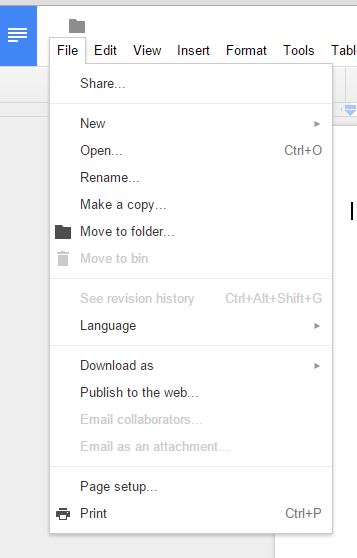
Again, if you’re using Chrome, a new tab will open.  This is your new document.  At the right hand side of the screen, click on ‘File’ and rename the document.

rename file


This will give you a small window where you can give the document a new name:

rename file 2

Once you have renamed the document, learn how to put in text, and format your work.

sample document


To create a table, simply point your mouse to the ‘Table’ heading in the toolbar and use the drop down options:

make a table

As with most computing skills, the only real way to learn this stuff is to try it out.  You can see the table I chose is 6 columns across by 4 rows down.  Simple to add!

Go on.  Give it a try.


Google in school

This year we decided to take on a new project in school – adapting Google Apps for Education.

Wha?

It works like this.  Google offer schools the facility to have a corporate email structure with cloud storage, shared calendars, internal websites and other bits & pieces.  And, if you’re a school, the cost is free.  Obviously, this is a big plus for any school – I don’t know of any that complain of having too many resources.

And what’s on offer?

  • Each user gets a gmail account (for us, student@mayfieldcs.net)
  • Create groups so that you can share resources or email them.
  • Each account comes with 30GB of cloud storage via Google Drive
  • Each account comes with Google docs (the ability to create documents, spreadsheets, presentations, forms)
  • Google Classroom (it’s new & I haven’t figured out its potential or pitfalls yet)
  • Google Sites (the ability to create websites internally or viewable externally)

So.  How do you actually tap into this resource?

If you go to this link, you can apply to Google to take on their Apps for Education suite.

Step 1 was to get registered.  This can be done using the existing domain for the school.  Google can then move your email to a gmail account.  The alternative is to create a new domain, but you need to jump through an extra hoop or two while Google verifies that you are acting on behalf of your school.

Step 2 is to get accounts set up within the school.  If you have a lot of students then what you do is to get the names of the students on a CSV file and allocate them all email identities and passwords.  This does take a bit of time – but that’s nothing compared to step 3

Step 3: take students to the computer room and get them all to open up their accounts.  this is best described as bedlam.  Chaos is a good alternative word at this point.

Step 4: get students to accomplish basic tasks such as opening drive, creating a document, or uploading files and sending an email.

Step 5: email the group you just signed up giving them instructions on how to add their account to their phone/tablet. (they like this bit)

A few teachers have started using the Classroom app, and seem to be happy with the ability to email notes and assignments to groups of students.

It’s early days yet, but there’s a lot of potential.

There’s a lot o resources out there from people who are a lot more experienced than I – but hopefully this will help someone get a start!


Lets discuss the Teaching Council

I’m conflicted.

The Teaching Council is the body that is charged with overseeing the profession of teaching in Ireland.  So, you would imagine that I would be all in favour of this.  After all, I’m a School Chaplain.  I spend my working days in schools and I witness the professionalism of my colleagues on a daily basis.  I see their hard work, dedication, inspiration.  I should be glad of anything that promotes that professionalism and recognises the hard work of so many teachers.

The Teaching Council is tasked with protecting the integrity of teaching.  It regulates “the teaching profession and promotes professional standards in teaching”.  Why then are so many of us angry with it?

My first taste of disillusionment with the Teaching Council came a few years ago, when the attacks on education (AKA the austerity budgets) were slashing resources and pay across the sector.  Many teachers wrote to the council asking them to speak up on their behalf.  In response we got the response that the council was all for protecting standards, yes.  But had no role in budget discussions.  I never kept a copy of the letter, but I’d love to be able to show it to you.

As the past few years have advanced, the Teaching Council has flexed its muscles more and more.

First, teachers who didn’t pay the €65 per annum registration would not be paid by the Department of Education & Skills.  This became an open threat with this press release stating that over 1,000 teachers could lose their pay.

Then we hear that the council has the power to investigate teachers.  Have our registration fees added up to become a war chest?  On what basis would teachers be investigated?

Most recently, the idea was proposed that teachers would have to engage in CPD in order to maintain their registration.  Admittedly CPD is very, very important.  But when technology changes so fast, and there are so many different ways in which to learn, who decides what is valid CPD, and who certifies it?  My interaction on Monday evenings #edchatie over on the tweet machine is something that is incredibly valuable.  I have learnt a lot by looking at what so, so many other teachers do.

My fears are not new, and they are not unique to me.  Have  a look here and here to see others’ concerns regarding the Teaching Council.

One problem is that many teachers have no faith in the Teaching Council, or see it as irrelevant.  If you do a twitter search for #teaching council you get one screen of results.  One screen for a body that has been in existence since March 2006.

So what is to be done?

  1. Be more flexible in recognising qualifications.  Engineers are good, very good, at maths.  People who qualified as teachers in other countries are teachers.  Don’t make it impossible for them to register here.
  2. Look at the registration fee.  Currently the Teaching Council is running a surplus of millions of Euro.  Use it or don’t charge it.
  3. Provide more courses that people want to engage in (or need to engage in, or would benefit from engaging in)
  4. Talk to the DES about getting course days and subject association days covered for substitution.
  5. Trust teachers.  Allow teachers to work together to create their own CPD.  Online interactions are very fruitful, but difficult to quantify for certification purposes.
  6. Do more to engage with teachers and see what we want for the development of our profession. There is little engagement at the moment.
Embed from Getty Images

First Communion & Our Primary Schools

Let me tell you a story, it’s a sad story, so please don’t laugh…

There was this little school where all the children got on well. All the boys & girls were well prepped and worked towards getting ready for their First Holy Communion.

The day arrived and the class assembled in church, going over their moves when the teacher noticed that little Mary was missing.  Mary never missed a day so the teacher got worried and she phoned Mary’s family.

“No problem,” they said “we got held up at the hairdressers so we’re going to skip the church and go straight to the hotel”.

I believe that First Communion in this country has gone in the wrong direction.   I first heard the above as an urban legend, but it has an air of possibility about it.  And that, for me, is sad.  First Communions and Confirmations are happening all over the country at the moment, and the commentary isn’t far behind.  Last year I remember Matt Cooper interviewing the owner of a Limo business who put in a policy that he wouldn’t accept First Communion bookings.  Why was the policy even needed in the first place?

A little context, First Communion is what is termed a ‘Sacrament of initiation’.  There are three of them: Baptism, confirmation, and Eucharist (Communion).  The idea is that a child on having taken part in all three sacraments will be a full member of the Catholic Church.  Very early in the Church’s history the three were separated out.

Funnily enough, in the modern world, they are not always separated.  A convert to Catholicism will receive all three in one go (in a rite called RCIA), and in the Orthodox church, all three also happen in one go.

Due to the Church having such an integral role historically in our primary schools we have a situation where the school is the place where children learn about, and are prepared for, the sacraments of Communion and Confirmation.  The sacraments have become rites of passage where the emphasis has moved towards the finery and the money spent rather than on the sacrament itself.

I’m against this.  Yes, make a big deal out of a sacrament if you want, but since when should 8 year old girls be worried about a dress costing €200 or more?  Since when should they have fake tan?  Since when is the contest in school later about how much money in gifts they got?

I think that I may agree with Ruairi Quinn on something.  <did I just say that?>

Like him, I think that it would be a good idea to take some of the preparation for communion out of the school.  Instruction in Religion could still happen in school, but move the responsibility for the sacramental preparation to the parish.

This has started in some places.  In my own parish children and their families attend a series of masses in preparation for their own Communion.  A group of parents meet on a regular basis to plan and prepare.  The links in the community are strengthened and those who choose to be part of the Church deepen their understanding.

Make communion something that a family, that a child has to opt into in their own time and you will very quickly find out the ones who actually want to be involved for what it is – part of the journey in the Christian Faith.

Things can’t change fast enough for me.  One of my daughters will receive her First Communion next year, and I would far prefer her to wear a pretty dress and not worry about the hype than be dressed in a miniature wedding dress and comparing hair-dos.

Lets put away the farce of Fake Tans and the Limos.  Let First Communion be for those who want to take part. Do away with the crap that has built up around it.


Education and Equality

We have an ideal that all students who enter our schools will be treated equally, that they will be treated fairly, and that they will be offered equal opportunities.

This is a myth.  Not true. Good PR.

You see, we live in an incredibly unequal society, and this inequality is reflected in our schools.  And this is a fact that our Minister for Education, Ruairi Quinn, seems to ignore.

So, just how does inequality show up in schools?

Well, all schools receive a running cost from the government depending on the number of students enrolled.  And yes, this does sound fair, but the costs of schools are such that the running costs will often exceed the money received from the government.  After all, taking the team to a match requires a bus, visiting the Young Scientist Exhibition or going on a field trip for geography requires money.  Some schools have more, some have less.  And this means the education experience of students can and will vary depending on the finance available.

You see, I don’t really believe the minister understands just what a disadvantage it can be to be from a disadvantaged area.  I mean how could he?  He hasn’t had to face a pay-cheque of less than €80,000 in years.  He went to a nice school (The Bish), and recently got to visit it with one of his advisers (coincidentally also a past pupil of the same school).

The thing is, if you attend a school where most of the parents have a decent wage, then the school looks for a top-up fee to support school activities.  These activities could include school tours, proper IT for classrooms (whether tablets, computers or whatever).

If your school is in a disadvantaged area, then things don’t look so good.   Being in a disadvantaged area you can expect to see higher rates of unemployment, lack of engagement with education, and social exclusion.  In short, schools could not in fairness ask for top up fees from these parents.  Any development is dependent on grants (which are getting scarcer).

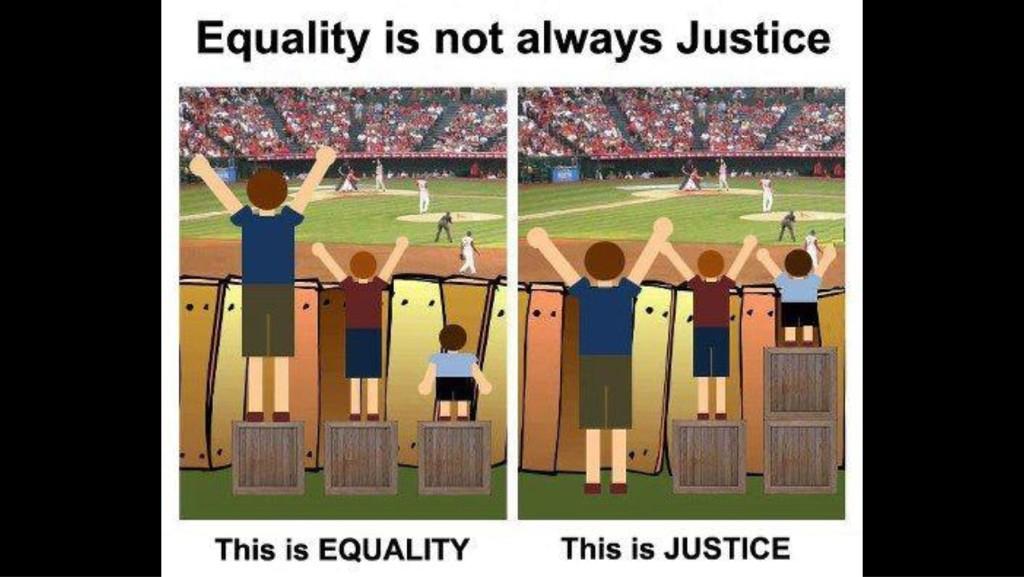
The picture looks a bit like this:


equality-justice

Just because schools receive a similar grant does not mean that the students will benefit from equal opportunities.  The playing field is not equal, a student who starts from a position of disadvantage will need extra help.

Our education system is in a lot of trouble at the moment.  Teachers are under pressure; we have a new Junior Cycle programme that is being rammed in despite the concern and opposition of thousands of teachers; school funding is being cut.

And yet, we claim we believe that education provides opportunities for students; that education is valuable; that education is more than just about measuring students. There’s a disconnect there and I hope that someday we get an education minister who actually believes in education and trusts teachers as professionals.

Our students deserve it.